Wednesday, May 31, 2006

The Visitation of the Blessed Virgin Mary

(Feast of the Visitation of the Blessed Virgin Mary-Year B;This homily was given 31 May, 2006, at Our Lady of Mercy, East Greenwich, R.I.; read Luke 1:39-56)

The scene of the Visitation of the Blessed Virgin Mary is one that is often beautifully depicted in Christian art. Yet sometimes, if we are not careful, we can reduce Mary to only a painting, picture or statue. We risk placing her so outside our own experience that she becomes some distant figure not entirely involved in the everyday world around us.

Fortunately, the Feast of the Visitation does not allow us to do that. Far from being statuesque or stationary, Mary in the Gospel for this feast is moving.

St. Luke tells us that she “set out and traveled to the hill country in haste” (Luke 1:39) to visit her cousin Elizabeth. Mary wastes no time manifesting the love of God in the world around her.

The love that Mary carries in her body, and the loved that wells up in her soul, does not allow her to stand still. She goes in haste to assist her cousin in need, and in that act of charity she sets in motion a whole chain of events that perpetuates the love she carries within.

Immediately upon arriving at the house of Zechariah, Mary’s voice sets the heart of St. John the Baptist in motion. Like one captive within the womb of St. Elizabeth, he cannot wait to get out and make Christ known in the world around him.

St. Elizabeth, for her part, cannot keep silent and sings out the praises of the Lord, blessing Mary and the God who works such wonders among His people.


In a very practical way, we can ask ourselves:

What lies dormant in our world today?

Where are the St. John the Baptists and the St. Elizabeths in our lives, waiting for the love of God to set their hearts in motion?

Where is the love of Christ waiting for a place to happen in our lives today.

Let us move in haste, following the example of Our Lady. May the Visitation become more than just a painting, more than just a picture in our lives. Like Mary, might we make the love of Christ real in the world around us.

Sunday, May 28, 2006

The Problem of Evil

(7th Sunday of Easter-Year B;This homily was given 27 & 28 May, 2006, at Our Lady of Mercy, East Greenwich, R.I.; read John 17:11-19)

For The past several years one of the most popular Broadway shows has been a play called “Wicked”. It’s based upon a novel by Gregory Maguire under the same title. Basically it’s a story about the Wicked Witch of the West, only before we come to know her in “The Wizard of Oz.”

Towards the beginning of that book, the Wicked Witch is away at boarding school, and has a conversation with her roommate Galinda (the one who will later become Glinda, the Good Witch, in “The Wizard of Oz”). They are talking about the reality of evil: Does it exist? Where does it come from?

At one point Galinda makes the observation that, while belief in God has become rather passé (people of Oz at the time could take it or leave it), the reality and the implications of evil are obvious and unavoidable.

In our own culture things are not really all that different. We do not have to be convinced of the reality of evil. We can simply open the morning newspaper or turn on the evening news. Evil exists in the world we live in.

That is the reality Christ is speaking of in the gospel, on the night before He dies, when He prays to the Father for the Apostles and for us. He prays:

Father, I do not ask that you take them out of the world
but that you keep them from the evil one.
—John 17:15


Following Christ does not necessarily remove us from the world and the experience of evil. Jesus, nonetheless, prays for us so that we can live in this world and serve Him, but all the while kept from the evil one. We are called to follow God’s plan, and God’s will, not the evil we see taking place around us.

Essentially, this is the same thing we ask for each time we pray the Our Father. We pray:

“Lead us not into temptation, but deliver us from evil.”

But with all that said, and after Jesus’ prayer and our own have been offered, much of what we know about evil remains a mystery. Down through the centuries, in the history of our tradition, some of the saints and theologians of the Church have helped us to shed at least some light on that mystery.

St. Thomas Aquinas says that evil is an absence of the good; it is a lack of some legitimate good which ought to be there. We can think of injustice, when someone’s legitimate rights are taken away or violated. That is an experience of evil. Or when one’s health or life is taken away seemingly without any sense of reason or purpose.

I recently learned that a young man with whom I had studied for the priesthood died this past Wednesday in tragic accident while vacationing with his family. He was 36 years old and had been a priest for only three years. That is what St. Thomas Aquinas means by an absence of the good; it is often how we experience evil in the world we live in.

St. Augustine describes evil in much more personal terms. In addition to an absence of the good, he also calls it “id quod nocet (that which harms).” Think about a time when something or someone harmed you our caused harm in the lives of those around you. That can happen in any number of ways. There are natural disasters or unexplained phenomena that cause damage and harm in the world around us.

Yet very often harm is caused by our own decisions and actions, by our misuse of freedom and the reality of sin. Our sins themselves are id quod nocet, that which harms. When we sin we harm our relationship with God, with one another, and ultimately we cause harm to ourselves.

But perhaps the most perplexing and often painful problem that we face with regard to evil is not the harm that we cause in the world, or the harm caused to us by others. The most challenging obstacle is often the suffering of those who are innocent. How are we to make sense of that?

In Dostoevsky’s great classic, The Brothers Karamazov, one of the main characters named Ivan brings up this very dilemma with his brother who is a monk. He tells him that he can accept his own suffering and the suffering of others if that is what God requires. As he puts it, “if all must suffer to pay for the eternal harmony.” But then what does that say for the suffering of the innocent, of children that have done nothing to harm anyone?

Ivan tells his brother that if that is part of the equation, that if God is going to require the innocent to suffer to restore “the eternal harmony,” then when he gets to heaven he will return his ticket for admission! He will not go to a heaven like that.

What Ivan fails to mention is the one thing his brother brings up immediately: it is not our own suffering that returns the universe to “eternal harmony,” and it’s not the suffering of the innocent that accomplishes that either. It is the suffering, death and resurrection of Jesus Christ that restores harmony and order to the world we live in. That’s where we receive our admission ticket to heaven.


And that is God’s response to the problem of evil. As St. John says in his gospel:

God so loved the world that he gave his only Son, so that everyone who believes in him might not perish but might have eternal life.
—John 3:16

God’s response to the problem of evil, to all the harm that we see in the world, to all suffering, is the response of love. It is the sacrifice of Christ Himself on the cross, for our forgiveness and our redemption. Now, that is not a response that answers all of our questions about evil and suffering. But it is a response that gives us hope in this life and in the life to come.

We can live in this world, finding consolation in Jesus’ prayer to “keep us from the evil one.” But ultimately, we can now participate in God’s plan to overcome that evil once and for all.

That is the Good News. Our sufferings and our struggles in this world are not meaningless. We can now unite them to the very sufferings of Christ, participating in the life of Christ and becoming a part of that same response of love that has changed, and continues to change, the world we live in.

Might we continue to see, in our lives, a greater participation in the life of Christ, the life He came to share with us; and may we continue to recognize more completely that Christ is our hope and strength, the one who prays for us throughout our time on this earth, and is ultimately our ticket of admission into the eternal life to come.

Thursday, May 25, 2006

The Ascension of the Lord

(Solemnity of the Ascension of the Lord-Year B;This homily was given 24 & 25 May, 2006, at Our Lady of Mercy, East Greenwich, R.I.; read Acts 1:1-11, Ephesians 4:1-13, and Mark 16:15-20)

One of my favorite C.S. Lewis quotes is one I have used many times, but it is well worth repeating. He said:

“The men and women who did the most for this world
were those who thought mostly of the world to come.
Aim at heaven, and you will get earth thrown in.
Aim at earth, and you will get neither.”

In many ways it summarizes our way of life as Christians: to be heavenly minded as we continue our lives here on earth. In today’s feast—the Ascension—that way of life is accentuated gloriously in the person of Christ, our Lord.

Jesus, when He comes to take on our humanity, does so much more than we could have ever hoped for. He not only forgives our sins, and redeems our humanity. In the ascension, Christ takes our humanity and glorifies it! The one who came from heaven to earth to become like us, has now returned to heaven and taken our human nature with Him, so that we can become like Him.

That fact alone should inspire us as we continue our earthly journey home to Him. Christ bids us to come follow Him, and we recognize that everything here on this earth matters; everything takes on eternal significance since it effects our relationship with God, with whom we will share all eternity.

But there is a second important reality we come to understand through the ascension, which is essential to our life here on earth. When Jesus ascends to the father, He does not become any less present here on earth. While He has taken His place at the right hand of the Father in heaven, Jesus remains on the earth through His body, the Church.

The same Christ who healed the sick, performed miracles and proclaimed the Good News to the poor continues to make His power and presence felt through the Church. That is the only way we could possibly understand the commission that He gives to the disciples in the Gospel. He says to them, as He prepares to ascend to the Father:

Go into the whole world and proclaim the gospel to every creature. Whoever believes and is baptized will be saved; whoever does not believe will be condemned.
—Mark 16:15-16

Now that’s quite a tall order, wouldn’t you say? Essentially, what Christ has commissioned them—and us—to do is invite everyone in the world into a personal relationship with Christ; to baptize all who believe in Him, helping to bring them to eternal life.

Obviously, that is not something that we can set out to accomplish on our own. We do not have the gifts, the talents, or the resources that are necessary to complete a task that lofty . . . but Christ does! Jesus ascends to the Father and then gives us everything we need to accomplish His will. It is a supernatural commission that we have been given, and He gives us supernatural help to complete it.

That is the significance of those interesting signs that Christ mentions immediately after He gives us this commission:

These signs will accompany those who believe:in my name they will drive out demons,they will speak new languages.They will pick up serpents with their hands,and if they drink any deadly thing, it will not harm them.They will lay hands on the sick, and they will recover.
—Mark 16:17-18

Jesus is not saying we should go out and pick up rattlesnakes! He does not want us to drink poison and see if we can stomach it. No, He wants us, and the entire world, to understand that this is His work, and He has equipped His Body, the Church, with grace and the supernatural means to carry it out.

As people of faith and followers of Christ, might we take inventory this day and come to realize more completely the gifts that we have been given to spread the gospel message in the world around us. We live in a world desperately in need of that saving and hope-filled message. It is no small task, but the one who calls us to it is able to do more than we could ever ask or imagine (Ephesians 3:20).

Today we continue our work here on earth with our hearts and minds always focused on Christ, and we never lose sight of the fact that:

“The men and women who did the most for this world
were those who thought mostly of the world to come.
Aim at heaven, and you will get earth thrown in.
Aim at earth, and you will get neither.”

Sunday, May 21, 2006

Deus Caritas Est

(6th Sunday of Easter-Year B;This homily was given 21 May, 2006, at Our Lady of Mercy, East Greenwich, R.I.; read 1 John 4:7-10 and John 15:9-17)

Deus Caritas Est. God is love. These are the opening words of the first encyclical letter from our Holy Father, Pope Benedict XVI. As he says in that letter, these words, God is love, “express with remarkable clarity the heart of the Christian faith.” They speak of the very image of God, and of our own destiny as persons made in that image (Deus Caritas Est, #1).

Those words—God is love—are taken directly from our Second Reading this morning, the First Letter from the Apostle, St. John. We know that John was the only apostle not to suffer the fate of martyrdom. He was exiled, instead, to the small island of Patmos.

There is a legend that—while John was of course not able to leave that Island—Christians nonetheless were allowed to come to see him. Week after week, according to that legend, crowds would come to hear him preach the Gospel, and the message he preached, week in and week out, was that message of love.

Finally, one day, someone said to him:
“Why do you always preach about the same thing, the same message of love? You spent years with Jesus Himself. Surely you must have something else to share with us.”

And John’s reply was:
“I have many things to share, but I continue to give that same message because people still have not responded to it.”

We have to wonder, if St. John were alive today, would he still be preaching that same message?

In St. John’s Gospel this morning, we hear the words of Christ given to the Church on the night before He died. He says:
“This I command you: love one another.”

Now, if we are honest, we can admit that the command to love is not always an easy one to follow. We live in a world that is often cold and indifferent. We can all think of people we have encountered in our lives that we find very difficult to love. How are we able to obey this command that Jesus gives us in the Gospel this morning?

The answer, I believe, is found in St. John himself. He says, in that Second Reading:

In this is love: not that we have loved God, but that he loved us and sent his Son as expiation for our sins.
—1 John 4:10

That’s the answer:
Not that we have loved God, but that He has loved us.

St. John—who gives us that insight—was a man who experienced the love of God completely. All throughout his Gospel, he never refers to himself by name. Over and over again John refers to himself as “the disciple whom Jesus loved.” John was a man loved by God; he never really got over that fact. It was something that never left his mind.

In the very beginning of St. John’s Gospel, in the first chapter, he describes how Andrew and “another disciple” came to know Jesus. The “other disciple,” of course, is John himself. He says that Jesus invited them both to follow Him. John puts it this way:

They went and saw where he was staying, and they stayed with him that day. It was about four in the afternoon.
—John 1:39


Now, that is a very odd description. Who cares that it was four in the afternoon? But it mattered to St. John because, on that day, at four o’clock in the afternoon, everything in his life changed. He was seized by Christ, loved by Love, and nothing was ever the same again.

Think about your own life. If you have children, you can probably remember the very hour that they were born. Or perhaps you remember exactly what time it was when you married the person you fell in love with. That’s what St. John is talking about. He was seized by the love of Christ, and it was four o’clock in the afternoon.

In the encyclical Deus Caritas Est, Benedict XVI describes this very same response we are to have to Jesus’ commandment in the Gospel. He says:

The “commandment” of love is only possible because it is more than a requirement. Love can be commanded because it has first been given.
—DCE, #14


In other words, God can command us to love because, in Christ, He has come right into our very lives and loved us first.

The Holy Father goes on to describe the Bible as the story of God’s love, a story in which Christ comes to us, seeking “to win our hearts”: at the Last Supper, when He gives Himself to us in the Eucharist; at the cross, when He gives Himself over for the forgiveness of our sins; and everywhere else in those first days of the early Church (DCE, #17).

All throughout history, if we look at all the greatest saints in the Church, we see this same Gift of God Himself in love; we see this same response from those whose lives were changed forever by that personal encounter with the God who is love. Their entire lives proclaimed that message: Deus Caritas Est; God is love.

We, too, are called to proclaim that same message; to witness to the God of love with our words and actions in this world. But that will never happen, it will never take place, until we have first been seized by Christ and loved by Him.

God calls us—just as He called St. John, and countless others—to know Him and be loved by Him; to know His forgiveness, His mercy, and His love in the deepest possible way.

Today we ask for that grace to open our hearts more completely to the God who is love, so that we may be faithful in responding to that command of Christ: to love one another, as God has loved us.

Sunday, May 14, 2006

Remain in Me

(5th Sunday of Easter-Year B;This homily was given 14 May, 2006, at Our Lady of Mercy, East Greenwich, R.I.; read John 15:1-10)

The image of the vine and the branches in this morning’s Gospel gives us a clear picture of just how radically dependent we are upon Christ for even the most basic necessities of the spiritual life. Like a mantra throughout that passage, Christ repeats those words, “Remain in me; remain on the vine; whoever remains in me and I in him will bear much fruit. Remain.”

This weekend is a timely opportunity to reflect on what it truly means to remain in Jesus. Just yesterday we celebrated the anniversary of the apparitions of Our Lady to three small children in Fatima, Portugal back in 1917. Today, of course, is also Mother’s Day, and the month of May. What better time to reflect on our Mother, Mary, as the perfect model for what it means to truly remain in Christ.

First and foremost, to remain in Christ is to remain in His word. As He says to the disciples in the Gospel this morning:

You are already pruned [made clean] because of the word that I spoke to you (John 15:3).

And then He goes on to encourage them, once again, to remain in that word.

Mary, above all the other disciples, was a woman of the word. From the beginning, at the annunciation, she was attentive to the word of God as it was given to her through the message of the angel. Her willingness to hear that word, her receptivity to the word of salvation, helped her to conceive the Lord in her heart even before she conceived Him physically in her body. All throughout her life she remained open and available to that life giving word of God and the words of her own Son. Mary was a woman of the word.

Are we that receptive to the word of God? As we listen to the gospel proclaimed here each week, are we open and available to what God is saying to us? Do we take time to read the Bible? St. Jerome, in his reflection on the word of God, says that “ignorance of Scripture is ignorance of Christ.” The Scriptures help us to see as God sees, to think as He thinks. Might we be men and women of the word, remaining in Jesus by remaining in His word.

Secondly, Mary was a woman of the Eucharist (Ecclesia de Eucharistia, #53-58). She would have been present at all the first Eucharistic feasts, those first Masses of the early Church. But long before that, she received the body and the blood of Christ when she welcomed Him into her body and gave Him life.

John Paul II says that at the incarnation—when God became man in Christ—at that mystery, Mary “anticipated . . . the Church’s Eucharistic faith” (EE, # 55). He calls her the “first ‘tabernacle’,” the first place in which the body of Christ was reposed. To remain in Jesus and to have life in Him is to remain with Him in the Eucharist.

The Main Chapel at the North American College, where I studied for the priesthood, has a unique floor design. The floor itself is made of white marble, but around the main altar where the Eucharist is celebrated each day, the marble tiles are all dark green and they flow out towards the pews and branch off to either side of that chapel. The significance is found in the very image that Christ shares with us this morning, that of the vine and the branches.

Separated from the vine—the very source of our life—we can do nothing. Separated from Christ in the Eucharist, we are like a branch that withers and is good for nothing, only to be thrown out into the fire. Like Mary, we are called to be people intimately united to Christ in the Eucharist. To remain in Christ is to remain with Him, and He with us, in the Eucharist.

Finally, Mary was a woman of prayer. Time and time again, when she encounters the great mysteries of her son’s life, we are told that Mary “kept all these things, reflecting on them in her heart” (Luke 2:19; 51). Mary remained in Jesus by keeping the mysteries of His life alive in her heart. She was a woman of great prayer.

Do we keep the mysteries of Christ present in our own lives through prayer? Do we take the time each day to be alone with God, the One who is the very source of our life and strength? To remain in Christ we must remain in prayer, able to recognize that in Him we have everything we need to live fruitful lives as people of faith.

This Mother’s Day, let us continue to look to Mary—woman of the word, woman of the Eucharist, and woman of prayer—as that perfect model of what it means to remain in Christ.

And may God continue to bless all mothers, all who have given us life and love, and most especially those who have taught us what it truly means to remain in Christ and to bear great fruit in Him.

Sunday, May 07, 2006

Good Shepherd Sunday: God and the Bride

(4th Sunday of Easter-Year B;This homily was given 7 May, 2006, at Our Lady of Mercy, East Greenwich, R.I.; read John 10:11-18)

This Sunday in the Church universal we celebrate the annual World Day of Prayer for Vocations. The reason we pray and focus our attention on this aspect of the life of the Church is simple: we are in need of religious vocations, and especially vocations to the priesthood. Pope Benedict XVI, in his message for this weekend, put it this way:

The mission of the priest in the Church is irreplaceable. Therefore, even if in some regions there is a scarcity of clergy, it should never be doubted that Christ continues to raise up men who . . . dedicate themselves completely to the celebration of the sacred mysteries, to the preaching of the gospel and to pastoral ministry.

Now, it shouldn’t surprise us that Pope Benedict is interested in vocations, or that this homily is about vocations. But what does come as a surprise, I think, is that thousands of Americans—Catholic and non-Catholic alike—are also interested in vocations to the priesthood.

I am referring, of course, to the “reality TV” series that recently aired on A&E called “God or the Girl.” You may have seen this program that follows four young men over the course of several months, as they must decide whether or not to enter a celibate life as a seminarian or remain in the world where they can date and continue their lives as single Catholic men. Again, as the title of the show suggests, they must make a choice: between either God or the girl.

Now, I have to admit, when I first heard about this show I was more than a bit skeptical. I could picture the cameras rolling as these four young men are being dropped off on an island with Brittany Spears and Paris Hilton! But having talked to people who have seen the show, and after reading much about “God or the Girl,” the overall message that comes through is really quite encouraging. It seems that even in the midst of our secular culture, people are generally interested—and even impressed—with the decision that many young men make to enter the seminary and embrace a call to celibate priesthood.

But with all that said, I still think there is something missing when it comes to that decision: “God or the Girl.” To say that a seminarian or a priest makes a choice not date or not to marry is really only part of the picture. Priesthood, like any vocation, is not a choice against something. It is ultimately a choice for something (or, to be more specific, a choice for someone).


Many times as a priest I am able to meet with young couples who are preparing for the sacrament of marriage. Whenever they talk about their life together, they never say:

“Father, we are so excited about our upcoming wedding, and about celebrating our decision to not see other people.”

No, they never say that! They say:

“I am looking forward to this wedding and my marriage to this person; I want to spend my life and give my love to this man or this woman.”

Marriage is not a choice against bachelorhood or a rejection of the single life. It is a choice for another; a choice for the beloved . . . and so is priesthood.

We need look no further than Jesus Christ, the great High Priest Himself, in the Gospel this morning, to see that love expressed in the most basic and compelling of terms.

Jesus refers to Himself as the Good Shepherd, who “lays down his life for the sheep.” At the very heart of Jesus’ identity and ministry, at the very core of who He is, we find this total gift of self, a gift of His very life for the sheep. Jesus goes to the cross out of love for His Bride, the Church.

In his document on the formation of priests, Pope John Paul II reflects on this very gift of self that Christ makes as the Good Shepherd. He says,

Christ’s gift of himself to his Church, the fruit of his love, is described in terms of that unique gift of self made by the bridegroom to the bride . . .Jesus is the true bridegroom who offers to the Church the wine of salvation (John 2:11).
—Pastores Dabo Vobis, #22.


He goes on to describe how the priest is called to share in that same spousal relationship, to make that same gift of self for love of the Church. So it’s not merely a choice between God or the girl. At its deepest level, the choice to follow Christ in the Catholic priesthood is a decision for God and the Bride, not God or the girl.

Now all of that sounds very theological and abstract. But it’s really not. In fact, in my own life, it is something that is very personal. For several years I struggled with the decision of whether or not to enter the seminary. If only I had waited a little longer, perhaps I, too, could have been on A&E’s reality TV show!

But my biggest challenge was trying to make that decision to give up the possibility of a rewarding married life, with a wife, children and all the things that most young men my age were considering.

The one thing that I could not see at the time, was that God was calling me to love every bit as much as any husband in the Church today, but that He was calling me to love in a very different way; He was calling me to share in that same love that Christ has for His Bride the Church. That reality, that truth, changed things for me. I began to look at the Church, the priesthood, and God’s call in my life in an entirely new way.

That is really what we pray for today, on this World Day of Prayer for Vocations: that all those who God is calling to love completely, and to give themselves fully to Christ in love for His bride the Church, may be able to hear that call and see that love in a whole new light.

Let us join with the Church throughout the world this day, in asking God for an increase in vocations to the priesthood and religious life. And may all those called to serve God as priests and religious today, reflect that love that Christ, the Good Shepherd, has for His Bride, the Church.

Sunday, April 30, 2006

Theo-Drama: Play of a Lifetime

(3rd Sunday of Easter-Year B;This homily was given 30 April, 2006, at Our Lady of Mercy, East Greenwich, R.I.; read Luke 24:36-48)

A number of years ago I was at a talk given by Catholic author and papal biographer George Weigel, and he was speaking on “The Soul of Pope John Paul II.” He expressed what he considered to be different aspects of the pope’s personal and spiritual life: for instance, he said that the Holy Father had a Polish soul, nurtured in his beloved homeland of Poland; he had priestly soul, formed over his long and fruitful ministry as a priest of Jesus Christ.

At one point he went on to describe how John Paul II also had “a dramatic soul.” Karol Wojtyla (John Paul II), as a young man growing up in Poland, had been an actor. He enjoyed writing and acting in plays, even continuing that activity clandestinely during the German occupation at the outset of World War II.

In saying that Pope John Paul II had a “dramatic soul”, Weigel was simply expressing how that sense of drama never really left him. He understood himself as a part of the greater drama of life, a play which God had written and in which he had been given a significant role to play.

Now this is not an entirely new way of looking at ourselves and our relationship with God. The great Swiss theologian, Hans Urs von Balthasar, in one of his works called the Theo-drama, explores what can best be described as the drama of life and the story of salvation. In that drama, he says, God is the Author, Director, and Actor on the world stage, but we are also actors who share that stage with Him.

The point of life, essentially, is to live fully the role that God has given us. Our freedom must work together with God’s freedom in order to follow His divine script. When our lives and our freedom are cooperating with His, we fulfill that authentic role. When they do not—when we abuse our freedom and cease to follow the divine will, when we sin—we lose sight of the true meaning of life and God’s plan for us in it.

In this drama, of course, it is Christ Himself who is the model of what it means to truly live out one’s role in this world. He is the one who always follows the divine script and freely loves both God and those around Him to the fullest possible extent.

The whole concept of the Theo-drama is a fascinating one, but it really only “works,” it only makes sense when we are able to understand that, first of all, there is a story that God has written and is writing; and, second of all, that we have a place in that story. That should sound rather obvious, but unfortunately it is not.

You may have heard the term “post-modernity” before; it’s been used to describe the culture we live in as seen through the art, literature, philosophy, and various components that make up that culture. One of the characteristics of our post-modern world is that we seem to have lost this sense of being a part of the greater story God has written. Think about the latest books, movies or TV shows; they nearly all present a very different picture of humanity than the one we find in the Theo-drama. In “post-modernity,” our lives become just a bunch of little stories that float around on their own. We are not connected to God or to each other.

The disciples in the Gospel we heard this morning, oddly enough, experience a situation very much like that. For three long years they had given their lives to Christ and followed Him. In that time they had seen amazing things: they watched Him preach the Gospel to thousands; they watched Him heal the sick, and raise the dead. And then, tragically, they watched Him suffer and die on the cross.

Now they find themselves gathered together in a locked room, fearful of the Jewish leaders and fearful of their own people. They have become separated from Christ and cut off from their own religious tradition . . . or so they thought.

Suddenly Christ appears to them and reveals the resurrection; they have not been separated from Him at all! And then He goes on to do the one necessary thing that remains: He reconnects them once again to their own faith tradition.

Jesus says to them:
“These are my words that I spoke to you while I was still with you, that everything written about me in the law of Moses and in the prophets and psalms must be fulfilled.” Then he opened their minds to understand the Scriptures.
—Luke 24:44-45

It’s the second time Christ does this in the same chapter of St. Luke’s Gospel. It was that important to Christ, and that important to the early Church, that He should open their minds and hearts to understand the story of their own salvation.

He would have brought them back to the Book of Exodus, and to the lamb that the people were commanded to sacrifice as a sign of their salvation from slavery and death in Egypt; and Christ would have told the disciples: “I am that Lamb.”

He would have taken them through the great stories of the prophets, who constantly called the people of Israel to return to God, the One who called Himself their faithful and loving husband. And Jesus would have said to the disciples: “I am that faithful husband.”

And He would have opened up the Book of Psalms for them, and let them listen to the voice of King David saying, “The Lord is my Shepherd.” And Christ would have said to them, “I am the Good Shepherd.”

Jesus opened their minds and hearts to the great drama of salvation, the one that they had apparently forgotten or maybe never fully understood. He helped them to see that they were not alone, not isolated and cut off from God’s plan or God’s people. They were a part of a much bigger picture, a much greater drama, written by God Himself.

This morning, here in this Church, Christ reminds us that we too have a role to play in that same drama. We, too, are a part of God’s plan of salvation. Our stories, our lives, are not isolated and disconnected. We belong to a much bigger picture and a much greater plan, and in that plan we must discover who we are and fulfill that role in the world we live in.

Today we ask God to open our minds to understand the scriptures, and our eyes to recognize Him as we gather here to celebrate this Eucharist. Like those first disciples, might we see and touch and hear Christ who speaks to us in the scriptures and gives Himself to us—Body and Blood, Soul and Divinity—in the Eucharist.

And leaving this Church this morning, may we come to understand that the curtain has been raised and the drama of our salvation is not yet finished. Might we be faithful in accomplishing the work that God has given each of us to do, and truly live to the fullest extent that Theo-drama, the role God has prepared for each of us as people of faith and followers of Christ.

Sunday, April 23, 2006

Divine Mercy-Breathing in and breathing out

(Divine Mercy Sunday-Year B;This homily was given 23 April, 2006, at Our Lady of Mercy, East Greenwich, R.I.; read John 20:19-31)


Just last year, the priests of the Diocese of Providence came together for a “Priest Study Day” at the Crowne Plaza in Warwick. Archbishop Dolan, from the Archdiocese of Milwaukee, was our presenter and he began by mentioning a book he had been reading on depression.

The author of that book had reached a point in her life where she felt completely helpless against the paralyzing power of that debilitating disease. The only thing that she felt she was able to do was simply to breathe in and breathe out. That’s it.

And yet, as basic as it may seem, that was the beginning of a brand new start for her life. Returning to that most fundamental element of human existence—breathing in and breathing out—was enough for her to begin that journey out of the darkness of depression and to move ahead towards healing and hope.

The point that Archbishop Dolan went on to make is that we sometimes need to get that basic in our own spiritual lives. When things seem difficult and complex, when we are struggling to find God in our daily lives, sometimes the most helpful thing we can do is to stop and breathe, recognizing the life of grace and the life of God within us.

Now, I know that this sounds a bit like pop-psychology, but actually it’s one of the most fundamental, biblical truths regarding the human person. Think about the Book of Genesis and the creation of Adam. We are told that:

The Lord God formed man from the dust of the ground, and breathed into his nostrils the breath of life; and the man became a living being.
—Genesis 2:7


God did not simply give life to us. He breathed life into us. We are made in the image and likeness of God, living beings who have the breath of God living within us. We have the power to be creative as God is creative. We have the power to live freely even as God Himself is free. Life is an amazing gift.

But with that power and with that gift comes tremendous responsibility. There are consequences to the choices and the decisions that we make. Our freedom is one of the things that make us most like God, but we know that it can also be used to turn us further away from Him.

That possibility, that reality, is what we call sin, and all of us have experienced it. In his 1984 document Reconciliation and Penance, Pope John Paul II describes the reality of sin in this way:

Man also knows, through painful experience, that by a conscious and free act of his will he can change course and go in a direction opposed to God’s will, separating himself from God (aversion a Deo), rejecting loving communion with Him, detaching himself from the life principle which God is and consequently choosing death.
—Reconciliatio et Paenitentia, # 17


In other words, that life which God breathes into the nostrils of Adam is something that can be extinguished within us. This is not the fault of God. He is the one who gave us life and breath to begin with. When we detach ourselves “from the life principle that God is,” the fault belongs to us.

The entire history of humanity, from the Garden of Eden to the present day, can be summarized as a series of breathing exercises. Either we have allowed the breath of God to flow through our spiritual lives, through our culture and the world we live in, or we have not. We are constantly in the process of accepting or rejecting the breath of life that God gives us.

The most dramatic example of this is found in the person of Christ Himself. He who came to bring us life and the fullness of God’s mercy is Himself rejected and crucified.

And yet at the very heart of that mystery of the death of Christ on the cross is the mystery of our own salvation. It is for our redemption and the forgiveness of our sins that Christ—with great love and boundless mercy—goes to the cross; He dies for each one of us. And with that event comes the fullest expression of the forgiveness, love and mercy of God.

That is why Christ walks into the place where the disciples are in today’s Gospel—standing before the very people who had used their freedom to turn away from Him just days before—and He announces to them: “Peace be with you.” That is why He shows them His hands and His side, revealing the very wounds that healed them, and each of us, from sin.

And then He does one of the most beautiful and strangest things recorded in the Gospels: He breathes on them! St. John describes that scene:

He said to them again, “Peace be with you. As the Father has sent me, so I send you.” And when he had said this, he breathed on them.
—John 20:21-22

He breathed on them. The same God who breathed into Adam the breath of life now breathes on the disciples and says to them:

“Receive the Holy Spirit. Whose sins you forgive are forgiven them, and whose sins you retain are retained.”
—John 20:23

God’s passion, His desire and purpose for every one of us, is to receive the breath of life anew, to be immersed in the mercy of Christ and His forgiveness flowing from the cross. But we must be willing to receive that mercy. We must be willing to breathe it in and breathe it out it in everything we say and do, at the very core of our being.

This can and should happen in all of the moments of our daily lives as people of faith. But the pre-eminent place where the mercy of God is received and where we are given the grace and strength to live out that mercy is through the Sacrament of Reconciliation.

Reconciliation is not an extra in the spiritual life. It “is the ordinary way of obtaining forgiveness” (Reconciliatio et Paenitentia, #31) for the sins we have committed. It is the sacrament Christ begins when he breathes on the disciples in St. John’s Gospel, and says to them: Whose sins you forgive are forgiven them, and whose sins you retain are retained (John 20:23).


Pope John Paul II calls that passage from St. John “one of the most awe inspiring innovations in the Gospel” (Reconciliatio et Paenitentia, #29). It is God’ s way of breathing new life into the souls of His people, into the life of the Church, and into the world we live in.

As we celebrate Divine Mercy Sunday this day, the incredible mercy that God is constantly breathing out into His Church, let us take the opportunity to be more attentive to our own breathing:

Have we made ourselves available to the mercy of God by a sincere recognition of our own sins and the need for forgiveness?

Have we, in turn, lived in a way that proclaims and manifests that same mercy which we have received from God?

Breathing in and breathing out: the most basic activities of human life. Just as our bodies cannot live without air, even so, our souls cannot truly live without breathing in and breathing out the mercy of God.

Sunday, April 16, 2006

Surprise! It's Easter!

(Easter Sunday-Year B;This homily was given 16 April, 2006, at Our Lady of Mercy, East Greenwich, R.I.; read John 20:1-9 and De-Coding Da Vinci by Amy Welborn)

What a surprise it was, just a week and a half ago, when the lost “gospel of Judas” was discovered. Imagine finding out, just at the outset of Holy Week, that everything we believed about the one who betrayed the Son of God was incorrect! Judas, apparently, was no enemy of Jesus, but His closest friend. His handing-over Jesus turns out to be the greatest favor of all. As Jesus tells him in that “gospel”:

“You will sacrifice the man that clothes me.”

In other words, You will set me free, Judas my friend.

Of course, the timing of this “new” gospel is no big surprise if we simply look at the ghosts of Easter past. For the past couple of years we have been “surprised” by all the stories of a supposed marriage between Jesus and Mary Magdalene, hidden through the centuries and now revealed by Dan Brown in The Da Vinci Code.

But my favorite Easter surprise comes from Holy Week of 1996, when reporters from the BBC revealed that they discovered a box that had contained the bones of a certain “Jesus, Son of Joseph,” found in a grave in Palestine. They wanted to know if this would affect the faith of the followers of Christ.

Of course, they failed to mention that they actually found many bone boxes labeled “Jesus, Son of Joseph,” since those two names were among the most popular of Jesus’ time!

So what do these three “discoveries” or surprises have in common (besides trying to spoil Easter for a whole lot of people)? All of them have to do with a very different vision of Christ and the human person than the Christian faith we profess each week. They belong to the tradition and worldview called Gnosticism.

You’ve probably seen that word, Gnosticism, in some of the articles about the “gospel of Judas.” The “gospel of Judas” is a Gnostic gospel. Details about the life of Christ in The Da Vinci Code, according to Dan Brown himself, are based upon the Gnostic gospels, namely the “gospel of Thomas” and the “gospel of Mary.”

The Gnostics—a philosophical-religious group from the 2nd and 3rd centuries—are a hard group to pin down. Their views and beliefs are a bit diverse, but there is a common vision they all seem to hold onto. In her book, De-Coding Da Vinci, Amy Welborn describes some basic themes of the Gnostics:

The source of goodness in life is spiritual, and the material world (our bodies, and the world we see around us) is evil.

We, as humans, are imprisoned within our bodies. We need to be set free (again, think of the “gospel of Judas,” when Jesus says to him: “You will sacrifice the man that clothes me.”).

Salvation comes from having a secret knowledge, but only a select few are worthy to receive it. You better know your stuff if you want to go to heaven as a Gnostic.


It is for good reason that the Church has rejected these Gnostic gospels from the beginning. The problem with the entire Gnostic vision of the human person is the insistence that this world and this life are not really all that important. If the material world and the body are evil, then we should be eager to get rid of them. Better for the body of Jesus to rot there in that grave in Palestine. The only thing that matters to the Gnostic is the life after this one. Nothing in this world matters.

How different is the vision we are given as followers of Christ! The real St. Mary Magdalene comes to the tomb this morning to anoint the body of Jesus, and what she finds instead is an empty grave. There is no body! It is the greatest Easter surprise of all: He is risen!

The radical message of the Christian faith is that Christ breaks into our world and takes on human nature entirely. The material world, and our humanity most of all, is something that is good, not evil. God takes it to Himself—soul and body—and He redeems it. He raises it up again.

The true message of the real Gospel is that this world—our bodies, our relationships, our care for the poor, our words and actions, our very lives—these things matter. We are not just spiritual beings waiting to be set free from this world. We are made of soul and body, and God wants us to live fully right here in this world, with our hearts set on the world to come. That truth should change us, and change the way we live our lives.


There is a very moving short story by English author D. H. Lawrence, called “Odour of Chrysanthemums.” It is considered to be a classic of English literature (it's also one of the only D.H. Lawrence stories you can read without having to go to confession afterward!).

The main character is a woman named Lizzie, and she is married to a coal miner who often comes home drunk or sometimes not at all. She despises him in her heart because he has become nothing more to her than a stranger.

As the story begins and her husband doesn’t show up after work, she begins to say to herself: He won’t be home tonight until they carry him in. And sadly she is right. She soon discovers that her husband has died accidentally in the coal mine. They indeed carry him home and she has the difficult job of cleaning him up, wiping all the dust and dirt from his body.

But in the midst of that awful task she discovers something alarming about this man as she clears away the coal and the soot. She begins to see things in him that she had never seen before. And then suddenly she begins to look more deeply at her own life, and she asks herself:

Who am I? What have I been doing? I have been fighting a husband who did not exist. He existed all the time. What wrong have I done? What was it that I have been living with? There lies the reality, this man.

The narrator goes on to say:

Her soul died in her for fear: she knew she had never seen him, he had never seen her, they had met in the dark and had fought in the dark, not knowing whom they met nor whom they fought. And now she saw, and turned silent in seeing. For she had been wrong. She had said he was something he was not.


On this Easter morning, as we celebrate the resurrection of Jesus Christ—soul and body—and reflect upon how He has taken on our humanity in all its weakness and all its brokenness . . . and redeemed it, what is our response as we look around us at the world we live in?

Like Lizzie in that story, we too are called to see something more than brokenness, weakness and sin. We are called to see each other as children of God, redeemed by Christ, and called to share in His resurrection. Might that Gospel and that vision of eternal life truly change the way we live in this world as we wait in hope for the life of the world to come.

Thursday, April 13, 2006

Holy Thursday-The Paschal Mystery Made Present

(Holy Thursday-Year B;This homily was given 13 April, 2006, at Our Lady of Mercy, East Greenwich, R.I.; read Exodus 12:1-14, 1 Corinthians 11:23-26)

Tonight we begin the sacred Triduum, those holy three days in which we enter more deeply into the very mysteries of Christ’s passion, death and resurrection. These days are always filled with inspiring and powerful moments. As we listen to the readings in these days, we can ask ourselves:

What must it have been like to be with Christ and the twelve Apostles in that upper room for the Last Supper?

To stand beneath the cross with Mary that Good Friday?

To come, with Mary Magdalene, to the tomb of Christ that first Easter morning . . . and find it empty?


In the Triduum we focus on these great events of Jesus’ life, the events of our own redemption. But somehow it is not enough for us to simply recall these events that occurred some 2,000 years ago. We need more than a memory, more than a remembrance of the redemption Christ won for us.

Jesus knew that. And for that reason, on the night before He died, at the Last Supper, Jesus takes the events of His own passion and death, and unites them once and for all to a meal.

It was the Passover meal, the one celebrated by the Jews each year to remember how God saved them from slavery and death in the land of Egypt. Jesus and the Apostles had celebrated that feast, that meal, all their lives. Yet, suddenly Jesus does something that had never been done before. We heard about it in that second reading from St. Paul.

He took the bread that was always used at that meal, and said, “This is my body” which will be given up for you. Then He took the cup and said, “This cup is the new covenant in my blood.”

The body that Christ will offer to the Father on the altar of the cross, and His blood that will be poured out on Good Friday for the forgiveness of sins, that gift of Christ Himself, is made present at that Last Supper in the form of bread and wine.

Christ then commands the Apostles to continue that sacrifice as He institutes the priesthood. He commands them to “Do this in memory of me.”

This is the gift we celebrate each Mass when we celebrate the Eucharist. It is the Passover fulfilled, the very sacrifice of Christ made present in every time and place. We truly believe as Catholics that the events of that first Triduum—Jesus’ sacrifice and death for us on the cross—are made present each time we celebrate the Mass.

Pope John Paul II, in his encyclical letter Ecclesia de Eucharistia, refers to this very mystery when he says:

In this gift Jesus Christ entrusted to his Church the perennial making present of the paschal mystery. With it he brought about a mysterious “oneness in time” between that Triduum and the passage of the centuries.
—Ecclesia de Eucharistia, #5

That first Triduum and those events of our redemption are, in a certain sense, “brought forward,” here tonight, and wherever the Eucharist is celebrated. They are perpetuated throughout all of history, and there is never a time or place where the great sacrifice of Christ and the glory of His resurrection are not present.


There is a man named Walter Ciszek whose cause for canonization is now being put forward. He was a young Jesuit priest from Pennsylvania who wanted nothing else than to bring the Gospel of Christ to the people of Russia. Near the beginning of World War II, he finally got his chance and he slipped behind the Iron Curtain under the guise of a common laborer.

It wasn’t long before the KGB discovered that he was a priest, and he was arrested and tried as a Vatican spy! It was a ridiculous charge and he expected them to discover this soon enough and he would be set free. Instead, the more they interrogated him the more convinced they became that he was sent to Russia to bring back secrets to Rome.

Walter Ciszek spent 23 long years in the Soviet prisons and the labor camps of Siberia. In that time he began to see that his dream of bringing the Gospel to the Russian people was being fulfilled in a very different way than he had imagined. Time and time again he offered the sacrifice of the Mass—at the risk of being executed—making Christ and the paschal mystery of the Triduum present even in the midst of Siberia.

Finally, one cold spring morning, he was told that he would be released from the prison camp in Siberia. He was given a new place to live, though still in many ways a prisoner within communist Russia, and he was therefore forbidden to celebrate the Mass and exercise his ministry as a priest. He did it anyway.

In his book, “He Leadeth Me,” Ciszek describes one night when he celebrated the Easter Vigil in the small hut or bolok that doubled as his “chapel”. Word had gotten out that he was celebrating the Mass and hundreds of people had come from all over to attend.

There were so many that he was unable to move—even to lift his arms. Communion had to be distributed after Mass, at 3 am. It was six hours later, at 9 O’clock in the morning, when he finally finished. Collapsing on his bed that morning, one thought was fixed in his mind: That all this had taken place in communist Russia!

Obviously, an event like that became known almost immediately. He was brought before the KGB the next day and told that he would be relocated. They warned him never to celebrate the Mass again. Yet time and time again he continued to make Christ present in communist Russia through the Holy Sacrifice of the Mass. Over and over again he would express the same sentiments: that it was worth the risk.


How many times has that same mystery been celebrated, in Russia, in Auschwitz, in a thousand forbidden places and in the midst of countless lives of faithful Christians from the time of Christ until this very day? How many dark and lonely places have been graced with the light of Christ made truly present in this holy sacrament of the altar through the hands of priests consecrated for that very purpose?

Tonight we celebrate that very mystery: the mystery of the Eucharist and the Sacrament of the priesthood whereby the Eucharist is perpetuated in every time and place.

But do the Eucharist and the priesthood mean the same to us as they did to Walter Ciszek and the people of Russia? This Holy Triduum we give thanks to God for the gift of Christ in the Eucharist and the gift of the priesthood that was instituted on that same first Holy Thursday night. May we spend the rest of our lives growing in these mysteries, and coming to recognize Christ’s paschal mystery present to us each time we celebrate the holy sacrifice of the Mass.

Sunday, April 09, 2006

Extravagant Love-Passion for His Passion

(Palm Sunday-Year B;This homily was given 9 April, 2006, at Our Lady of Mercy, East Greenwich, R.I.; read Mark 14 & 15)

Who are the people we ordinarily associate with the Passion of Christ? Each year we hear about the Apostles, Mary and the women of Jerusalem; we hear about the scribes and the Pharisees, Pilate and the Romans, and a host of other characters.

But in St. Mark’s introduction to the Passion of Christ we are introduced to a person we do not usually think of when we reflect upon the suffering and death of Jesus: the woman with the alabaster jar of precious ointment. St. Mark recalls how she breaks open that jar and pours out its expensive contents in an expression of extravagant—even provocative—love.

Although we may not often consider her to be an important part of Jesus’ Passion and death, Christ Himself declares of her, and her alone:

Wherever the Gospel is proclaimed to the whole world,
what she has done will be told in memory of her.
—Mark 14:9

As we meditate on Christ’s Passion this coming week, we are called to do more than simply tell her story; in a certain sense, we are called to enter into her story; and not her story only, but the story and the very life of Christ Himself.

This is Holy Week, the singular most significant week in the Church’s liturgical year. It is the week that we focus, in a particular way, on the most central mysteries of our salvation:

On Holy Thursday of this week, we gather to celebrate the Mass of the Lord’s Supper. We remember that Christ, on the night before He died, gave over His body and poured out His blood in the Eucharist for the life and sustenance of the Church.

On Good Friday we gather as God’s people to remember and celebrate the sacrifice of Christ on the cross, that glorious death which purchased for us salvation and the forgiveness of our sins.

Finally, at the Easter Vigil, we assemble once again as Church on Holy Saturday evening, our souls and our sanctuary filled with light, and celebrate with great joy the resurrection of Christ.

This is indeed Holy Week, and God calls each of us to enter into it with joyful expectation and hopeful anticipation as the day of Easter draws near. We are called to celebrate not only these solemn feasts, but to truly open our hearts to God in all the areas of our lives: in our homes and families, in our relationships, and in the work place.

Might we break open what is most precious within each one of us this Holy Week, pouring out upon Christ and His Body, the Church, our faith, our devotion, our passion for His Passion. And might our hearts be opened more completely this year to receive the Easter message of Christ’s resurrection with joy.

Saturday, April 01, 2006

The Law of the Gift

(5th Sunday of Lent-Year B;This homily was given 2 & 3 April, 2006, at St. Elizabeth, Bristol, R.I. and 3 April, 2006, at Our Lady of Mercy, East Greenwich, R.I.; read John 12:20-33 and Gaudium et Spes, #24)

The Christian life and Christian faith is often experienced and expressed in paradoxes. We see this many times in the Gospel. Jesus says that those who humble themselves will be exalted; those who wish to be greatest must become the servant of all.

Perhaps one of the greatest paradoxes in Scripture is found in St. John’s Gospel, the one we listened to this weekend. Jesus tells us that the path to a fruitful and productive life begins at death!

Unless a grain of wheat falls to the ground and dies, it remains just a grain of wheat; but if it dies, it produces much fruit.
—John 12:24


Ultimately, Christ is talking about the mystery of Easter. Each year we prepare ourselves to celebrate that mystery, which marks the journey from life, to death, to life eternal. Christ Himself comes to experience that mystery in its fullness through His passion, death and resurrection.

Yet each one of us is called to live out this mystery every day. Christ tells us that:

“Whoever loves his life (clings to it) loses it” (John 12:25).

“Whoever hates his life in this world (
learns to give it away) will preserve it for eternal life” (John 12:25).


The theological term often used to describe this way of life is the Law of the Gift. Essentially what is means is that we are really and completely fulfilled only when we learn how to give more completely of ourselves (Vatican II, Gaudium et Spes, #24).

It is no coincidence that we reflect on this passage from St. John’s Gospel and meditate on the Law of the Gift this weekend, on the 1-year anniversary of the death of our beloved Pope John Paul II.

Perhaps more completely than anyone in this past century, Pope John Paul II taught and lived the Law of the Gift all throughout his life. As a young man, and then a priest, but most especially as Vicar of Christ and successor to St. Peter, Pope John Paul II exemplified the Law of the Gift and left us all an example of how to build a life following that law.

Many people still remember the year 1978 as the year we elected two Popes. Having returned to the city of Rome for the second conclave in a matter of weeks, many of the cardinals began to question what God might be saying to them regarding the election of the next successor to St. Peter.

For hundreds of years they had elected Italian Popes; might God be moving them in another direction, to think outside the parameters that they were used to working within?

It is said that, after many days of deliberation, the momentum began to sway in the direction of the young Polish Cardinal, Karol Wojtyla [that is John Paul II’s baptismal name]. As they were counting the ballots it suddenly became clear that there were enough votes in his favor, and that he would be the next Pope.

Witnesses say that Wojtyla looked visibly shaken, and that he bent over and placed his face in his hands. One of the Cardinals began to fear that he would not accept the nomination! Think about how different that is from a Presidential election, with the balloons and streamers and everyone shouting for joy.

He understood what God was asking of him. He understood well the Law of the Gift: that God was asking him to give no less than everything.

Earlier that week, before the conclave, in a sermon he was asked to preach at a Mass for the recently deceased John Paul I, he reflected on this incredible responsibility, and the depth of the love which God demands of every Pope. He had said:

The succession of Peter, the summons to the office of the papacy, always contains within it a call to the highest love, to a very special love. And always, when Christ says to a man, “Come, follow me,” He asks him what He asked of Simon: “Do you love me more than do the others?” Then the heart of man must tremble . . . Christ’s command, “Come, follow me,” has a double meaning. It is a summons to service, and a summons to die.


And so, the Cardinal in charge approached Karol Wojtyla’s desk that afternoon, while the others waited silently and watched. He asked him if he was willing to take up this office to which God was calling him, and Wojtyla replied immediately, without hesitation: “I accept.” The grain of wheat had fallen, and the fruit was about to begin.

John Paul II’s entire papacy modeled this dying to self, with which he began his journey as the successor of St. Peter. Time and time again he would have to surrender himself to the will of God and lose himself in order to gain Christ.

I’m sure most people are familiar with the fact that John Paul II was the first Pope in history to have been shot. It was one of the darkest days in the last century, when—in 1981—an assassin attempted to kill the Pope right in St. Peter’s Square.

The day was May 13, the same day that the Blessed Virgin Mary had once appeared to three young children in Fatima. When asked how it was possible that the bullet which entered his body had missed every major organ, the Holy Father said: “One hand fired [the gun], but another guided the bullet.”

And then the Pope went on to do something that sent shockwaves throughout the world. He forgave the man who had tried to kill him. In an address taped from his hospital bed and broadcast from St. Peter’s Square that very Sunday, the Holy Father said:

I pray for that brother of ours who shot me, and whom I have sincerely pardoned. United with Christ, Priest and Victim, I offer my sufferings for the Church and for the world. To you, Mary, I repeat: Totus tuus ego sum.

That last part of the Pope’s message, his motto as Pope, is a Latin phrase which sums up John Paul II’s total consecration to Jesus, through Mary: Totus Tuus, I am totally yours.

It is to Mary that John Paul II attributed that miraculous intervention. The bullet that went through his body that afternoon was later taken from the floor of the Pope-mobile, and placed—by John Paul II himself—in the crown of the statue of Our Lady of Fatima, in Portugal. It remains there today.

But what a curious message he was sending that Sunday: “United with Christ, Priest and Victim, I offer my sufferings for the Church and for the world.”

What does that mean? What does it mean for someone to offer their sufferings up for the Church? For the world? What it means is that we saw the fruit of John Paul II’s papacy; always we saw the fruit. But behind it all was that grain of wheat falling to the ground.

Falling, like his face in his hands at the conclave when he was elected Pope. Falling, like his body on the floor of the Pope-mobile, offered up to Jesus, through Mary. Falling, like his voice towards the end of his life, shaking with age and the dramatic effects of Parkinson’s disease, but speaking nonetheless the eternal words of God.

John Paul II was a man who lived out the Law of the Gift, and we in the Church and people throughout the world are continuing to see the fruits of it:

Unless a grain of wheat falls to the ground and dies, it remains just a grain of wheat; but if it dies, it produces much fruit.
—John 12:24


But it is not only the Pope who is called to live out the Law of the Gift. All of us are called to realize that eternal truth, that “man can fully discover his true self only in a sincere giving of himself” (Gaudium et Spes, #24).

I was 23-years old when I first felt God calling me to the priesthood. I remember my response at that time, how I had decided in my heart: God, I am willing to do anything that You want, to be anything You want me to be . . . anything but that!

It took me 5 years before I was able to prayerfully discern and grow in my life and faith, until I could see that this vocation that God was calling me to was the very thing that I also wanted all along. I realize now that being called to the priesthood, and responding to that call, is the greatest thing that has ever happened in my life. It’s the Law of the Gift, the reality that we are never really fulfilled in this life until we learn first to give more completely of ourselves to God and those around us.

As we continue to remember Pope John Paul II and seek to follow his example in our daily lives, how is God calling each of us to live out the Law of the Gift more completely in our own vocation, in our relationships with each other and with Him?

Like Pope John Paul II, let us learn to spend our lives loving God and those around us more completely than ever before, because our lives are not truly lived until we learn how to give them away.


If you are in the area, please join us for:

The Spiritual Legacy of Pope John Paul II
St. Elizabeth's Parish Mission

Bristol, R.I.
April 3-6, 7:00 PM


Sunday, March 19, 2006

Cleansing the Temple

(3rd Sunday of Lent-Year B;This homily was given 19 March, 2006, at Our Lady of Mercy, East Greenwich, R.I.; read Exodus 20:1-17; John 2:13-25)

One of the oldest and most basic ways of establishing a relationship between persons is through what is called a covenant. We see this everywhere, even in our own culture. The most common covenant is the covenant of marriage. A man and a woman make a commitment and agreement with each other, to love one another, to care for one another, to be faithful to each other. It is a covenant of equals.

There is also such a thing as a covenant between two unequal parties. A king would make a covenant with his subjects; a landowner would make a covenant with tenants, agreeing to pay them a certain wage in exchange for the produce they gathered from the land.

Perhaps the greatest covenant in human history is the one we read about in the book of Exodus; it is the covenant God makes with the people of Israel. Having just freed them from slavery in Egypt and put them on the road to the Promised Land, the Lord leads Moses to the top of Mount Sinai, and there He makes a covenant with the people.

The covenant God makes with Israel is a covenant of love and the conditions of that covenant are crystal clear:

You have seen for yourselves how I treated the Egyptians and how I bore you up on eagle wings and brought you here to myself. Therefore, if you hearken to my voice and keep my covenant, you shall be my special possession, dearer to me than all other people, though all the earth is mine. You shall be to me a kingdom of priests, a holy nation.
—Exodus 19:3-6

This covenant of love, the Ten Commandments, with all of its prescriptions and implications, essentially comes down to two sides of the same coin: love of God and love of neighbor.

The first three commandments are directed towards the love of God:

I, the LORD, am your God, who brought you out of the land of Egypt, that place of slavery. You shall not have other gods besides me.

The people were to put nothing before their relationship with God: not family, not business, not personal interests. God was to have pride of place over everything else that they did and over all other priorities in life.

You shall not take the name of the LORD, your God, in vain. For the LORD will not leave unpunished the one who takes his name in vain.

They were to honor God with their speech, never taking His name in vain or dishonoring His name by the way they conversed with others.

Remember to keep holy the Sabbath day.

The people of Israel were to observe that day as a day of rest, and a day of worship. No work was to be done, and God was to be honored in a particular way, for the Lord Himself rested on the seventh day.


The rest of the commandments are concerned with love of neighbor; if we love our neighbor, then we will not steal, we will not covet, we will not commit adultery, we will not kill . . .

To observe these commandments was to dwell in the fullness of life that God was calling them to in the Promised Land. They would be at peace and live in a harmonious relationship with God and those around them.

The history of the nation of Israel is essentially a set of footnotes as to how well or how poorly they observed this covenant and followed the commandments that God had given them. All throughout the Old Testament, God constantly sends them the prophets to call them back to fidelity, back to the covenant that God had made with them on Mount Sinai.


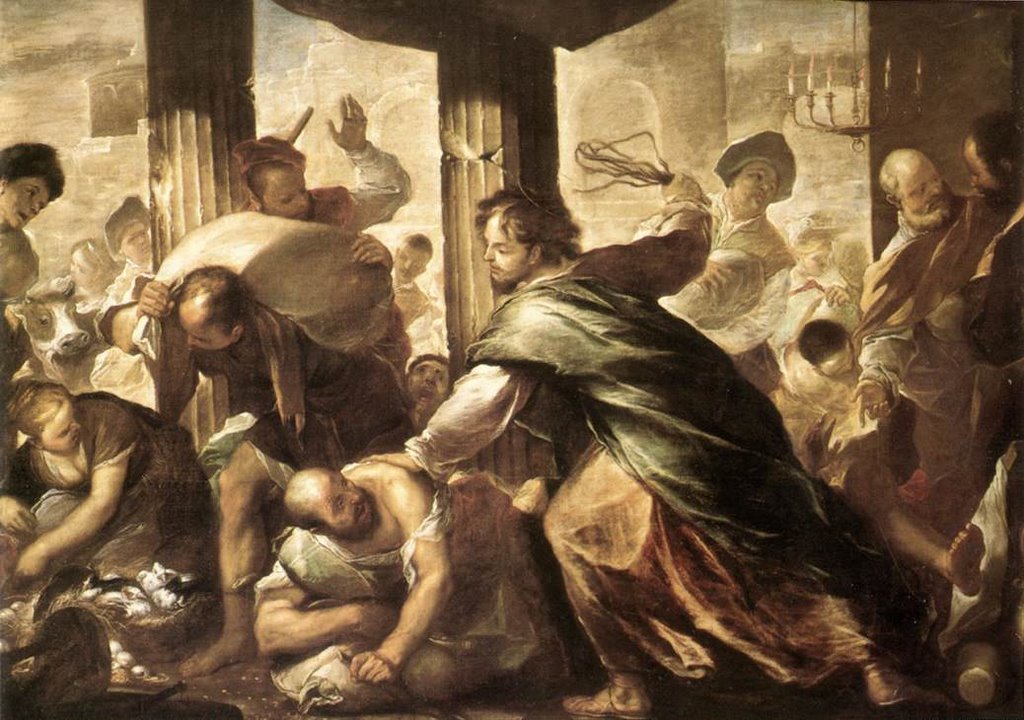
This morning Jesus enters the Temple, the place where the fullest expression of love of God and neighbor should be observed, and He finds anything but that expression. It was the place where the people of God would come together as one, and worship the Lord, their God.

But instead of love of neighbor, Christ finds exploitation of neighbor. He enters what should be a house of prayer and a place of worship, and instead He discovers a marketplace. God is no longer top priority here; now it’s business. And Christ is furious.

We see Christ in rare form in the cleansing of the Temple. In a display of righteous indignation, He makes a whip out of cords and drives away the moneychangers. But the Fathers of the Church have always seen in this event much more than Christ chastising the people. He is preparing them for an entirely new sacrifice, and a new and everlasting covenant.

The cleansing of the Temple is a dramatic and explosive event in the life of Christ, and one of the few moments that is included in all four Gospels. The scene itself goes much further than a reprimand of the moneychangers. St. John tells us that Christ:

Drove them all out of the temple area, with the sheep and oxen . . . and to those who sold doves he said, “Take these out of here.”
—John 2:15-16

He drove out the sheep and the oxen? What did they do wrong? He orders the doves to be taken out of there. For what reason? Christ is preparing the people of Israel for the day that is fast approaching when the animal sacrifices will cease and there will be an entirely new form of worship.

Historically, we know that in 70 A.D., less than 50 years from this scene in St. John’s Gospel, the Temple itself will be completely destroyed by the Roman Empire. Christ predicts this very event in the Gospels. He says, “Not one stone will be left upon another.”

What He has come to bring is a new sacrifice and a new covenant. No longer will there be a lamb sacrificed every year at Passover to remember the deliverance of the people of Israel. No longer will there be a sacrifice of a lamb every morning and every evening in the Temple for the atonement of sins.

As John the Baptist points out when Christ walks by the banks of the Jordan River: “Behold, the Lamb of God, who takes away the sins of the world.” The new sacrifice and the new covenant is Jesus Christ. There is only one sacrifice, and one man, Christ the Son of God, who has come to establish a new covenant between God and man.

We have been baptized into the very life of Christ; as St. Paul tells us: “Christ in you, the hope of glory” (Colossians 1:27). The Holy Spirit lives in us through baptism and we now have the ability—by the grace and mercy of God—to live out the covenant like never before. We are able to love God and neighbor the way Christ commands us because He gives us all we need to do so.

Each time we come together as the people of God to celebrate the Eucharist, we renew this new covenant that God has made with us. We hear the words of Christ, spoken in love at the Last Supper, when He said:

Take this, all of you, and drink from it.
This is the cup of my blood,
The blood of the new and everlasting covenant.


On this Third Sunday of Lent, as we continue to prepare ourselves for the celebration of Easter, how is God calling us to open our hearts and minds more completely to this covenant of love He has made with each of us? Where have we failed to love God or love our neighbor, and where are we in need of change?

If Christ were to enter the Temple of our hearts, or our assembly, what might He drive out and purify? We ask Him to come and cleanse the Temple of our souls and renew our lives in this new and everlasting covenant, that we might be ready to celebrate in the fullness of joy His resurrection this coming Easter.

Sunday, March 12, 2006

Metamorphosis

(2nd Sunday of Lent-Year B;This homily was given 12 March, 2006, at Our Lady of Mercy, East Greenwich, R.I.; read Mark 9:2-8)

The Transfiguration is one of the most amazing events in the New Testament. Years later it remained etched in St. Peter’s mind; he never forgot that day. To one of the early Churches St. Peter wrote:

We were eyewitnesses to his majesty. For when he received honor and glory from God the Father . . . we were with him on the holy mountain.
—2 Peter 1:16,18


But what did Peter and those other disciples see? What were they “eyewitnesses to” on that “holy mountain”? Mark’s Gospel describes a breathtaking scene in which Christ “was transfigured before them, and his clothes became dazzling white” (Mark 9:2-3). Imagine what it must have been like to see Christ transfigured on that mountain.

The Greek word St. Mark uses is metamorphothe; it’s where we get the word metamorphosis. It means to change (meta) form (morphe). Jesus was literally trans-formed right before their eyes. They no longer saw His human form, which had been so familiar to them. Instead, they saw His divine form, the glory that He shared with the Father and the Holy Spirit before the foundation of the world.

St. Paul, in his letter to the Philippians, talks about that same transformation, that same metamorphosis, but in reverse. He describes how the Son of God left the glory of heaven, humbled Himself, and became man. The word he uses, morphe, is the same one we just heard in St. Mark’s Gospel. St. Paul says that although Christ:

Was in the form (morphe) of God, he emptied himself, taking the form of a servant . . . And being found in human form, he humbled himself and became obedient unto death, even death on a cross.
—Philippians 2:6-8


That was the appearance of Christ in His humanity; it was the very thing that the disciples had seen all throughout their time with the Lord. But now—for that brief moment on the mountain—Christ reveals Himself to them in His divine glory. But why? St. Leo the Great says that there are two reasons why Christ chooses Peter, James and John to witness His transfiguration.

The first is so that they will be strengthened for that time when Christ will be taken from them and crucified. Having already seen His glory in the Transfiguration, they will be able to endure the scandal of the cross. They will eventually come to see that the suffering Jesus experiences is a voluntary one, where, as St. Paul says, he "humbled himself and became obedient unto death, even death on a cross" (Philippians 2: 8). In the Gospel of John, Jesus says:

I lay down my life in order to take it up again. No one takes it from me, but I lay it down on my own. I have power to lay it down and power to take it up again.
—John 10:17-18

In those days following the cross, the disciples will look back on what happened on the Mount of Transfiguration, and remember that our glorious Lord gave Himself willingly so that we might have new life.


The second reason for the Transfiguration is to give the disciples a glimpse of the glory that Christ is calling them, and us, to share in for all eternity. That is why Christ “emptied Himself” to begin with, the reason why He took on our human form; so that we could undergo the greatest transformation, the greatest metamorphosis of all: to share in the very life of God.

Now, the temptation is to try to walk through door number 2—the glory of heaven and eternal life with Christ—without ever passing through door number 1: the labor and the toil, as well as the suffering and the cross that we all must share with Christ. You’ve heard it said before: no cross, no crown.

We see that temptation revealed in St. Peter, who desires nothing else but to remain on that mountain for as long as Christ will permit it.

“Rabbi,” he says, “it is good that we are here! Let us make three tents: one for you, one for Moses, and one for Elijah” (Mark 9:5).


Peter likes it up there! They’re away from all the crowds, away from the toil and the difficulties of everyday life. And Christ is certainly calling Peter to one day share in that serenity, to bask in that glory . . . but not yet! Not now! There is still much more to be done in the days to come, for Christ and for Peter.


St. Augustine, in one of his sermons on this scene of the Transfiguration, becomes so worked up about Peter’s desire to stay on the mountaintop that he stops preaching to the people and begins to speak and shout to St. Peter himself! He says: “Come down, Peter! You were desiring to rest on the mountain; come down!”

Then, reflecting on how Christ humbled himself, how He emptied Himself to take on our human form, Augustine goes on to say to Peter:

The Life came down, that He might be killed;
The Bread came down, that He might hunger;
The Way came down,
that He might be wearied on the journey;
The Fountain came down, that He might thirst;
And you [Peter] refuse to suffer?

—St. Augustine, Sermon 78, #6


The Transfiguration is given to us on this Second Sunday of Lent so that we, too, might catch a glimpse of the glory that Christ is calling us to share in, but most of all so that we may be strengthened in our resolve to follow Christ on the way.

But where are we tempted, like St. Peter, to stay on the mountaintop and not labor here on the earth? What are those things Christ has called us to do—in our vocation, in our daily practice of faith, in our Lenten observances as Catholics?

We are reminded today that even as Christ came down from heaven, and took upon Himself our human form and burdens, we too must strive here on earth to complete the work and the mission that He has entrusted to us.

And the goal of all this striving, the very point of everything that Christ wants to accomplish within us, is transformation; His desire is that we will undergo a metamorphosis in our own lives so that we will come to share in His glory forever. But that will never happen unless we are willing to come down with Him and labor here on this earth.

This second Sunday of Lent we renew our commitment to follow Christ on the way to Easter. Strengthened in the power of this sacrament we come to share in the Eucharist, we make ourselves ready to go back down the mountain, with St. Peter and so many saints after him.

And laboring here on this earth, might we experience that metamorphosis, that transformation of our hearts and minds, which sets us apart in this world as followers of Christ who will one day share His glory.

Wednesday, March 01, 2006

Ash Wednesday-The Time is Now

(Ash Wednesday-Year B;This homily was given 1 March, 2006, at Our Lady of Mercy, East Greenwich, R.I.; read Matthew 6:1-18, 2 Corinthians 5:20-6:2)

Today we begin the holy and penitential season of Lent, a time of preparation for Easter. Traditionally, Lent has often been seen as journey. On that journey we focus—in a particular way—on the practices of prayer, fasting and almsgiving.

Yet in the Gospel, Christ challenges us to look at our motives and attitudes toward these spiritual practices. How are we following them, and for what end? When we fast, when we pray or give alms, are we doing it for God or only for ourselves?

St. Augustine has a unique way of looking at the reality of sin. He says that it is actually love “turned in on itself.” We tend sometimes to take the focus of love off God or away from others, and try to turn that focus back on ourselves. The glory that God should be receiving through my prayer or fasting or whatever it might be, is instead used to glorify myself.

The point of our Lenten journey is to recognize this tendency and to ask God for the grace to change it. For that reason, the theme that runs all throughout Lent is that of repentance, a turning away from sin and selfishness and a turning back again to God.

Cistercian monk and spiritual author Thomas Keating, O.C.S.O., in one of his Lenten reflection books, talks about this recognition of our tendency to sometimes turn love back in on itself. Far from being discouraged by this recognition, he says that it can become the true beginning and very turning point of our Lenten Journey. Keating writes:

Now we experience the full force of the spiritual combat, the struggle with what we want to do and feel we should do, and our incredible inability to carry it out . . . Such insight is the beginning of the real spiritual journey.
—Thomas Keating, O.C.S.O., Journey to the Center


Why is that the beginning? Because finally we begin to see, more and more clearly, that we need God in order to live and to love the way that we are called to. We need the grace that only He can give, in order to live out the Gospel and live in full communion with God and with each other.

God offers us today a vision of Easter; it is a picture of ourselves in a whole new light, living out a love directed more completely towards Him and towards those around us.

Are we willing to be taken by Him towards that vision? Will we walk that path on our Lenten journey towards Easter? The invitation could not be any clearer than we find it in the second reading for this Ash Wednesday:

In an acceptable time I heard you, and on the day of salvation I helped you. Behold, now is a very acceptable time; behold, now is the day of salvation.
—2 Corinthians 5:20—6:2

Sunday, February 26, 2006

"Jesus, why do your disciples not fast?"

(8th Sunday in Ordinary Time-Year B;This homily was given 26 February, 2006, at Our Lady of Mercy, East Greenwich, R.I.; read Mark 2:18-22, CCC #1438, 2043)

“Jesus, why do your disciples not fast?”
This is a very good question Jesus is asked in Mark’s Gospel. Fasting—abstaining from food or some legitimate pleasure for a spiritual benefit—was a practice well established in the Jewish tradition. The Pharisees followed it; so did the disciples of John the Baptist. And Jesus’ own disciples would also continue that same spiritual discipline. As Christ says in the Gospel:

As long as they have the bridegroom with them [the disciples] cannot fast. But the days will come when the bridegroom is taken away from them, and then they will fast on that day.
—Mark 2:21-20

The bridegroom being “taken away from them” is a reference Jesus makes to His own death and subsequent resurrection. Now until that happens, of course, the disciples will not fast; they will rejoice and celebrate in the presence of Christ. But after the death and resurrection of Jesus, after His ascension into heaven, the time for fasting will come.

For centuries now the Church has continued to follow the spiritual practice of fasting. Jesus Himself modeled this for us in the Gospels; for forty days and forty nights He fasted in the desert. All of the saints fasted in one way or another. Many of you know much better than I do about the days when abstinence from meat on all Fridays throughout the year, and fasting on all the days of Lent, was a routine part of the Catholic mindset. And let’s be honest, maybe it was too routine.

The Second Vatican Council sought to purify our practice of fasting and abstinence, to help us better understand the reasons we deny ourselves to begin with. As you know, the canonical requirements of abstaining from meat every Friday and fasting on all the days of Lent were dispensed with, and we were encouraged, instead, to embrace fasting and self denial voluntarily. Many people still do that.

The American bishops at the time encouraged the faithful to fast: “as a gesture of solidarity with the passion of Christ, as an act of fidelity to the Christian past, and to help ‘preserve a saving and necessary difference from the spirit of the world.’”

—“Why Catholics Fast,”
by Eamon Duffy in First Things, March 2005

But unfortunately today, I think most of us would admit, about the only thing many people fast from is fasting itself! What has happened to this spiritual discipline that has been an integral part of our heritage as Catholics since the time of Christ? Could we not ask the same question that Jesus is asked in the Gospel: “Jesus, why do your disciples not fast?”

With Lent only just a few short days away, I would like to offer briefly three of the more practical and valuable reasons why fasting and self denial are essential and indispensable aspects of our spiritual lives as Christians.

Firstly, as the saints and spiritual writers have always pointed out, denial of self and fasting creates a void in our lives, and God is then able to fill that void with Himself.

When we choose not to eat the food that we enjoy or listen to the music we like, then we experience a literal hunger or a silence within. This points us to the reality that—in the deepest part of ourselves—we hunger and thirst for the living God. Fasting opens us up to this deeper encounter with God, who alone can fill our every need.


The second reason why the disciples of Jesus fast is because denying ourselves legitimate pleasures, choosing to abstain from the things that are a good for us, ultimately gives us strength to deny those pleasures that are not good, the ones that are sinful.

It is when I am able to deny myself that huge piece of chocolate cake that I simply cannot wait to get my hands on that I then have the strength to not say that unkind word to that person who is really getting on my nerves.

I have the ability to deny that opportunity to gossip, to reject that impure thought or that image that pops up on the computer screen because I have already been strengthened in denying myself the good pleasures that I could have had all along. Fasting and self-denial strengthen our will and help us to follow Christ more faithfully, and even more joyfully, in the everyday decisions and difficulties of life.

The final and most important reason for the spiritual discipline of fasting and self-denial is that it brings us into a more intimate union with the person and the sufferings of Jesus Christ, the one whose ultimate sacrifice and self-denial won for us eternal life.

St. Paul prays, in his letter to the Philippians:

That I may know [Christ] and the power of his resurrection, and may share his sufferings, becoming like him in his death, that if possible I may attain the resurrection from the dead.
—Philippians 3:10-11

This is a form of self-denial that I believe most people practice everyday, whether they know it or not. We all have our crosses. Every single one of us has to face difficulties and struggles in the spiritual life and in our faith.

It may be many small crosses, those minor annoyances that stretch out our patience and really test our faith. Perhaps it is a much larger cross: the death of a loved one, difficulties in marriage or in the family, it might be an addiction, or an illness that seemed to come from nowhere.

All of us experience the cross. But it is our choice to take up that cross and follow Christ. One of the most challenging commands of Jesus is found in the Gospel when He says to the disciples:

Whoever wishes to come after me must deny himself, take up his cross, and follow me.
—Matthew 16:24 (Mark 8:34, Luke 14:27)

Christ is not trying to be exclusive or elite here; He is simply stating the fact that we cannot follow Him if we are unwilling to walk the path He walked; that path was very often one of self-denial and suffering.

The great Irish missionary, Amy Carmichael, in her poem, “Hast thou no scar?” sums up this point completely. In that poem, the speaker is Christ and He asks:

Hast thou no scar?
No hidden scar on foot, or side, or hand?
I hear Thee sung as mighty in the land,
I hear them hail thy bright ascendant star,
Hast thou no scar?

Hast thou no wound?
Yet I was wounded by the archers, spent,
Leaned me against a tree to die; and rent
By ravening beasts that compassed me, I swooned:
Hast thou no wound?

No wound? No scar?
Yet, as the Master shall the servant be,
And pierced are the feet that follow Me;
But thine are whole: can he have followed far
Who has nor wound nor scar?

—Amy Carmichael, Toward Jerusalem


Lent is only a few short days away, and Christ is calling each of us into a deeper relationship with Him, asking us to draw closer to Him than ever in this season of grace. Today we simply pray:

Lord Jesus, help us to practice fasting and self-denial, to open up a void in our lives that only You can fill. Give us strength in denying the legitimate pleasures of life that we may be able to say "no" to the things that harm us. And give us the courage to deny ourselves this Lent, to take up our cross and follow You.