Sunday, December 19, 2010

Inception, St. Joseph and the Dream of God

The Dream of St. Joseph
by Philippe de Champaigne, is dispalyed at the National Gallery in London.

(Fourth Sunday of Advent; This homily was given on 19 December, 2010 at the American College of the Immaculate Conception in Leuven, Belgium; See Matthew 1:18-24)

One of the big blockbuster films of this past summer, and a movie that is right now at the top of the charts for DVD sales, is the movie Inception. It is a very well written and compelling film filled with great special effects and intense drama. The characters in that film have the ability to go deep into the dream world of the people around them, extracting secrets from their subconscious and sometimes even inserting ideas—hence the name inception—that have the power to change lives.

Of course, as intriguing as the movie is, at its very foundation it is fiction. Certainly we cannot delve into the subconscious minds of those around us and enter into their dreams against their will. But nonetheless, in the Gospel this weekend we are shown not a fiction but the fact of the inner life of St. Joseph, husband of Mary. We are given an insight and a glimpse into his dream world, and in that place nothing less than our eternal salvation is at stake. We sit on the razor’s edge of St. Joseph’s dream, waiting breathlessly for his reaction to the angel’s voice…but we will come back to that in a moment…

For starters, St. Joseph is not the first dreamer we encounter in the Scriptures. In fact, he is named for one of the great Old Testament dreamers, Joseph the Patriarch. We encounter that Joseph towards the end of the Book of Genesis. He is only a teenager the first time we meet him, and he is dreaming about his brothers, arrayed before him and bowing before their younger brother. That dream is followed by another in which the sun and the moon and eleven stars of the sky are arranged before him; his father and mother, as well as his brothers, bowing in fealty to Joseph (see Genesis 37:5-20).

All too eagerly, and perhaps even imprudently, Joseph shares these dreams with his brothers, who immediately take offense at him. They decide at first that this “master dreamer” (Genesis 37:19) needs a dose of reality, and conclude that he should die; later they change their minds and sell him off into slavery instead. “After all,” they reason, “he is our brother” (Genesis 37:27). Thank heavens for small favors!

We are all familiar with the rest of the story. Joseph gets taken into Egypt where he suffers many hardships and is even thrown unjustly into prison. But soon Pharaoh himself has a vision that perplexes him and so he sends for Joseph, who is renown even in the land of Egypt as an interpreter of dreams. Joseph, with the help of God, unlocks the mystery of Pharaoh’s dream and saves not only Egypt, but the surrounding countries, as well, from famine and destruction. His brothers, true to his prophesy, indeed come and bow before him, even before they realize that he has graciously become their savior.

It is a compelling and beautiful story which reveals God’s power and ability to save us even in spite of our own human frailties and sins. But truth be told, when Joseph’s brothers mock him as “master dreamer,” they could not have been further from the truth. In fact, in all the Scriptures there is only one Master Dreamer, and that is God. His master dream comes to be revealed to us not at the end of the Book of Genesis, but at its inception.

In the opening chapters of the Book of Genesis we are given God’s dream for the human family. It is a dream in which the man and the woman live together in a mutual relationship of love and freedom. There is harmony and peace between them, and that same harmonic relationship exists between them and the rest of the created world. There is a just and peaceful accord between all of creation and God, who wills to walk with the man and the woman in the cool of the evening, content simply to spend time with them (see Genesis 3:8).

Of course, very quickly that dream is shattered; God’s dream for the human family is broken into a thousand pieces after what we come to understand as Original Sin enters the picture. Although we understand the truths of that mythic tale in a way different from our historical reality, nonetheless we see that broken dream played out over and over again in our everyday lives. Perhaps we ourselves, or those we know and love, are in the midst of that very brokenness:

Broken dreams…broken lives…broken promises…broken relationships…and the list goes on and on.

One of the great tragedies today is that so many people experience this brokenness and simply give up on the dream all together. They conclude that peace and harmony in this world is simply not possible and they cease to even try. That is a very sad thing. But even worse is the reality that many in this post-modern world have given up on even the hope for happiness and peace beyond this life. They have given up on even the possibility of an eternal life in which God will set things right and give us “far more than all we ask or imagine” (see Ephesians 3:20).

It is such a paradox because deep within our hearts we long for nothing else than this eternal dream of God; we desire nothing greater than the restoration of this harmony and peace deep within us, and spreading out to all of the relationships of our lives. We cannot help but to dream!

And so thanks be to God that He has revealed to us in the Scriptures this weekend and in the midst of our Catholic faith that He has no intention of ever giving up on that dream! No matter what happens, and no matter how many times we break away from His plan for our lives, God is relentless in making this dream a reality for us.

He so longs for its fulfillment that He is willing, even desirous, to come right into our brokenness, to become broken Himself on the wood of the cross, so that we can be healed and have the hope of an eternal life with Him. He desires to become one like us so that we can become more and more completely like Him. That is the hope we eagerly wait for in this Advent season and it is the plan of God revealed to us in the Scriptures. But that plan this weekend is almost derailed at its inception by none other than St. Joseph!

It is not because St. Joseph is selfish and wants to do his own thing, like Adam and Eve in the Garden of Eden. No, it is because St. Joseph was a good and righteous man of God and because he had a dream for his life. St. Joseph, like almost all righteous Jews of his time, would have had a dream for marriage and a family, to raise up faithful children of Israel. Suddenly that dream is shattered as Joseph comes to learn that this woman, who by all appearances is so holy, so pure, so perfect…is suddenly so pregnant! And he knows that he is not the father. His dream was broken and we are told in the Gospel this weekend that he had decided to divorce her quietly; he was going to separate himself from Mary and her Child. Immediately the angel of God intervenes and makes it clear, No, Joseph! That is not the right move!

His plan and dream for life was a good one, a holy one even, but it was simply not sufficient. The angel is essentially telling him, You have to dream a whole lot bigger, Joseph, because God is going to do something in your life beyond your wildest imagination. He has a dream greater than you could possibly foresee, and you are an intimate part of that dream.

St. Joseph, for his part, does not miss a beat. We are told that as soon as he awoke he did what the angel had instructed him. In a moment he was able to place his own dreams aside and to broaden his vision to the eternal dream of God. This Fourth Sunday of Advent, are you and I able to do the same?

We all have dreams and hopes for the future; we all have plans and desires that we hope will come to pass. But so many times we hold onto those dreams with both hands and fail to see that God often desires something more, something greater “than all we ask or imagine” (Ephesians 3:20).

Are we willing to broaden our vision to the master dream of God, to His great desire for our eternal happiness, and let everything else in our lives conform to that dream? We must be willing and even eager not only to conform ourselves to that dream, not only to surrender ourselves to it, but to love it! Only there will we have the true freedom to let go of our own plans and to find the greatest desires of our hearts fulfilled in Him.

This Advent, may we find the courage to dream bigger than ever before and seek the inspiration that comes from God Himself and His Son, Jesus Christ, because this is the season, above every other season of the year, when dreams come true.

Friday, December 03, 2010

The Vision and the Fire of Advent

St. Francis Xavier 1506-1552

(Friday of the First Week of Advent, Feast of St. Francis Xavier; This homily was given on 3 December, 2010 at the American College of the Immaculate Conception in Leuven, Belgium; See Isaiah 29:17-24, Psalm 27 and Matthew 9:27-31)


We have already come now almost one quarter of the way through the Advent Season, and our readings today encapsulate the message of what it means to be a people waiting for the revelation of God in Christ. We wait in hope for the vision of God who comes to us in the person of Jesus Christ, God incarnate.

In our first reading the Prophet Isaiah anticipates this vision when he announces boldly that “out of gloom and darkness, the eyes of the blind shall see” (Isaiah 29:18). When the Messiah comes He will open the eyes of all to see the beauty and the power of God.

The Psalmist speaks of that same longing and yearning when he sings of his great desire to “gaze on the loveliness of the Lord and contemplate his temple” (Psalm 27:4). It is not enough for us to hear about God or simply to know a great deal about Him. No, we long to see Him and to look upon His loveliness even here, “in the land of the living” (Psalm 27:13).

One of the most beautiful prayers in the liturgy is found in the Christmas Season, which we will enter in a few short weeks. One of the Prefaces for the Eucharist Prayer in the Christmas Season offers this wonderful prayer to God:

In the wonder of the incarnation
your eternal Word has brought to the eyes of faith
a new and radiant vision of your glory.
In him we see our God made visible
and so are caught up in love of the God we cannot see.

The eternal Word who is Christ has brought to our eyes of faith that new and radiant vision of God. When Christ comes to dwell among us as a man we finally catch a glimpse of the God who we know loves us and whom we could never see had He not revealed Himself to us in the person of Jesus Christ.

Our Gospel today shows us this reality in a striking and vibrant way. Those two men beg Christ to heal them and restore their sight. The very first thing—or better, Person—they see when their request is granted and their eyes are opened is the God-Man, Jesus Christ, the eternal Son of God. What longing, what yearning we have to see Him as we await the coming of Christ this Advent!

Truth be told, this is the very mission and vocation of the Christian: to see God and be swept up in this “new and radiant vision,” to have our eyes opened to His glory and His unsurpassable mercy. Then we cannot help but go out into the world and proclaim His wonders so that the eyes of all may be opened to that same vision of God. We want all the word to see what we have seen and to taste what we have tasted in the body and blood, soul and divinity of Christ.

But to do that we have to be able to see what God sees when He looks at us and at the world we live in. We have to see the sin that is inevitably a part of our daily struggle, but even more we need to see ourselves and those around us not only as sinners but as men and women loved infinitely by God. We need to see the men and women whom God is willing to suffer and die for. You have heard the expression before: hate the sin but love the sinner. We separate the sin from the sinner and try to see as God sees.

One of the great temptations and dangers of the disciple of Christ is to take both of those realities together—the sin and the sinner—and to despise them both. Our worst days as disciples are often the times when we fail in this regard. When we do that, seeing only sinful people doing sinful things, then we also risk losing the vision of God Himself. We can no longer see Him clearly and all that He desires for us to behold as we follow and serve Him.

Such was the temptation which St. Francis Xavier faced, whose feast we celebrate today. Francis Xavier was sent by St. Ignatius of Loyola to bring the Gospel of Jesus Christ to the people of the East Indies. By no means was he the first person to do that. In our tradition it is St. Thomas the Apostle who is sent by Christ Himself to bring the Gospel to the people of India. St. Francis Xavier would follow in the footsteps of countless men and women who tirelessly and faithfully brought the Gospel to those who longed to hear it.

But what he encountered when he arrived there was not only the fruit of the fidelity of the missionaries that had gone before him. He also encountered the infidelity of the followers of Christ who had long forgotten the Gospel they were sent to proclaim. He encountered, along with many zealous and praiseworthy disciples, also clergy who had given cause for scandal and the brutality not only of the pagans in that land but especially of the many Christians who should have known better. One account tells how “when slaves were atrociously beaten, their masters counted out the blows on the beads of their rosaries” (Butler’s Lives of the Saints, IV).

How would you and I have responded to such brutality? What would have been our attitude as missionaries in that strange and mysterious place? The response of St. Francis Xavier was one of tears almost to the point of blindness, but not the kind we would first think. He writes to his spiritual father, St. Ignatius of Loyola:

“The dangers to which I am exposed and the tasks I undertake for God are springs of spiritual joy, so much so that these islands are the places in all the world for a man to lose his sight by excess of weeping: but they are tears of joy.”

St. Francis Xavier saw the sin that was rampant in that place and he saw the atrocities and the squalor that comes with the loss of the vision of God, but he also saw the countless souls whom God loved so dearly, and that made all the difference. His heart was on fire with that same love that sent Christ to the cross, willing to die for our salvation, and Francis Xavier was overwhelmed with love to the point of tears; he was nearly blinded by the tears of joy that flowed from a heart on fire with the love of Jesus Christ.

That is precisely why St. Ignatius sent him to the East Indies to begin with. After serving faithfully by Ignatius’ side following his ordination to the priesthood, Francis Xavier was not immediately sent out into the missions. He waited and longed to preach the Gospel but year after year that assignment never came. Finally, one day, Ignatius released him with the now famous exhortation, “Go and set the world on fire!” St. Francis Xavier went and did exactly that.

It is the fire of the Holy Spirit, and only that fire, that has the power to renew the Church in the time of St. Francis Xavier and in our own time today. It is only the fire of divine love that can so inflame us to hate the sin and love the sinner as we proclaim Christ unreservedly to the world we live in.

May we come to know that love here in this place as we prepare to receive Him in the Most Holy Sacrament of the Eucharist. May we see here in the Eucharist that “new and radiant vision” of the glory of God and come to know Him in whom “we see our God made visible and so are caught up in love of the God we cannot see.” May our eyes be opened to that vision and may God send us out from this place to set the world on fire.

Wednesday, November 10, 2010

Thanksgiving and Grace

(Wednesday of the Thirty-Second Week in Ordinary Time; This homily was given on 10 November, 2010 at the Pope's College -founded by Pope Adrian IV- in Leuven, Belgium; See Luke 17:11-19)

Thanksgiving. Gratitude. Giving thanks is something we are usually taught at a very young age. We receive a gift or a kindness from a relative or friend and our parents immediately seek to instill in us an attitude of gratitude. Perhaps they purchase a box of “Thank-you” cards for us after a significant event and encourage us to begin that age-old practice.

But what, exactly, is at the root of our need to give thanks? Is it simply the obligation to “ingratiate” ourselves to others, showing them that we were indeed worthy of the gift received? Is it merely a healthy habit which we cultivate to keep up appearances and expectations? Or is it something more?

If we look to the liturgy of the Church we discover the power of thanksgiving as something which affects us deep within. One of the Prefaces for the celebration of weekday Mass (Preface for Weekdays IV) communicates the following humble prayer to God:

You have no need of our praise,
yet our desire to thank you is itself your gift.

Our prayer of thanksgiving
adds nothing to your greatness,
but makes us grow in your grace,
through Jesus Christ our Lord.

Our prayer of thanksgiving
adds nothing to your greatness…

There is nothing we can do or say that will ever add anything to God; He is complete and content and in need of nothing from anyone. But there is much that He can do, and indeed does, to increase His life in us.

Our prayer of thanksgiving…makes us grow in your grace, through Jesus Christ our Lord.

It is one thing to receive a gift, to be the recipient of some grace; but it is another thing altogether to grow in that gift and to allow it to reach its full potential. One can earn a Master’s Degree or a PhD—have received opportunities for education and intellectual growth—but still not allow those gifts to reach their full potential.

We can receive the greatest gifts of all—faith, our Catholic identity, the Eucharist—and still fail to grow spiritually even after having been given such tremendous graces. We often receive good things from God and from others, but we are also called to grow in those gifts so that they will bear the kind of fruit God intends from the beginning. Thanksgiving has everything to do with that fruitfulness.

Our Gospel this afternoon, from St. Luke, reveals this brilliant flowering of the gift of grace within the human heart. We are told there were ten lepers who stood at a distance from Christ and called out to Him for mercy. Telling them to go and show themselves to the priests of the temple (a requirement according to Mosaic Law) they immediately obey and suddenly, on the way, they are cured! Yet only one of them returns, thankful.

All ten were healed; ten received the gift and grace of physical healing, but for nine of them the grace stopped there. They were healed by God…but that is all that happened! Not so, for the one who returns to give thanks. He comes back and falls down at the feet of Jesus. He is filled with gratitude and praise. His entire life has been changed, not just his body. And then Jesus says something to him that He says to none of the others:

“Stand up and go; your faith has saved you.”
Luke 17:19

Salvation has come for this man! He has been changed and transformed not just physically, but spiritually, as well. Body and soul he has been touched by God in the deepest part of himself. It all began with that initial grace received from Christ, and was brought to fruition through the gift of gratitude:

Our prayer of thanksgiving
adds nothing to your greatness,
but makes us grow in your grace,
through Jesus Christ our Lord.

Having received such a gift and such a grace as Jesus Christ here in this Holy Mass, how will our gratitude bear fruit in our lives this day? How is God calling us to cultivate an attitude of gratitude so that all the graces we receive may reach their fulfillment in lives of joyful service and love for God and those around us?

Tuesday, November 09, 2010

Feast of Dedication of St. John Lateran

(Feast of the Dedication of the Lateran Basilica; This homily was given on 9 November, 2010 at the Chapel of The American College of the Immaculate Conception in Louvain, Belgium; See Ezekiel 47:1-12)

This morning we celebrate the Feast of the Dedication of the Basilica of St. John Lateran, a Church which adorns herself with the modest title of being “Mother and first of all the Churches in Rome and of the world.” But it is not so much that title we celebrate, nor even the basilica itself as much as it is the unity and universality that they represent.

Long before the popes began to preside over the assembly at St. Peter’s Basilica they made St. John Lateran their residence. For centuries that was the center for the visible source of our unity; today what we truly celebrate is the affection we have for the Vicar of Christ on earth, our Holy Father, Pope Benedict XVI. And we have much to celebrate, much to be thankful for.

For decades as a theologian and subsequently as Prefect for the Congregation for the Doctrine of the Faith he provided clear and engaging teachings, in articles, books and statements, on Christ and the Church. As our Holy Father he has continued to teach, govern and sanctify the Church through his writing and example. But one aspect of the pontificate of Benedict XVI that I would like to emphasize this morning is his consistent witness—in city after city, country after country, time and again—in the face of what has often revealed itself as bitterness towards the Catholic Church and the Catholic message.

To be sure, that bitterness has come at times as a result of the sins and even scandal caused by members of the Church. Pope Benedict XVI has addressed this himself many times. Yet there is also a bitterness that has come as a result of the world that we live in, a world that is growing increasingly more secular, increasingly more closed-off from the things of God. There is a sense of bitterness, then, that can result from the Catholic message itself which our Holy Father represents; a message that emphasizes the need for conversion and forgiveness, an acknowledgement above all of the merits of Jesus Christ for us, not an emphasis on our own merits and accomplishments, however grand and distinguished they may be.

Yet in the face of such bitterness, our Holy Father has consistently borne witness to Jesus Christ and the message of the Gospel, in humility and charity, immersed in the power and joy of the Holy Spirit.


The impact of this witness has been tremendous. In city after city, country after country, from Washington, D.C. and New York, to France, Great Britain and recently in Spain, time and again that witness has affected the lives of thousands of people. Many, perhaps not most but certainly many, of those who were bitter about their experience of the Church or bitter with regard to the circumstances of their lives, have been touched by the life and ministry of Pope Benedict XVI. His reception in places across the globe has been positive and powerful for the Church and the world we live in.

I would suggest this morning that this witness offered by our Holy Father is not one exclusive to him as the Vicar of Christ. It is a witness that is universal in scope, one which we are all called to embrace. We are all called, as members of the Body of Christ, to bear witness to Jesus Christ and His Gospel, with humility and charity, immersed in the power and joy of the Holy Spirit. The Prophet Ezekiel, in our first reading this morning, shows us a vision of what that witness of the Church can look like. In his vision, which prefigures the Church, Ezekiel sees a temple and describes how there is water flowing from the sanctuary of that temple. It flows out well beyond the confines of that place of worship and reaches all the way to the sea (see Ezekiel 47:1-12).

Now usually when a river flows into the sea those waters, laden with salt and brine, will flow back into the river and turn its fresh water brackish. Not so with this river, describes Ezekiel. Instead, he says, the water flowing from the temple and into the sea changes the sea itself! That great body of water, bitter to the taste and expansive in size, is changed and transformed by the river flowing into it. In fact, Ezekiel relates how even the trees which line the banks of that great river are vitalized and they bear fresh fruit each month; their leaves are useful as medicine for healing.

It is a beautiful and vibrant picture of the mission of the Church and of the witness we are called to bear. We are called, at this Eucharist and in this sanctuary, to be immersed in the Body and Blood of Christ, so that we can go out into the world and bear witness to our Lord in all we say and do. Where will the rivers and tributaries flowing from our temple spread out to this day? How might God be able to bring healing and wholeness to those who have perhaps grown bitter in their experience of life? May we, like Pope Benedict XVI, bear witness to Jesus Christ and His Gospel, in charity and humility, fully immersed in the power and joy of the Holy Spirit.

Tuesday, October 19, 2010

Vigilance

Vasari's Garden of Gethsemane

(Tuesday of the Twenty-Ninth Week in Ordinary Time; This homily was given on 19 October, 2010 at the Chapel of The American College of the Immaculate Conception in Louvain, Belgium; See Ephesians 2:12-22 and Luke 12:35-38)


Christ in our Gospel this morning instructs and admonishes his disciples to be vigilant; to be watchful and ready; to be prepared to receive Him when He comes to them (Luke 12:35-38). And although we are not given a list by St. Luke of the disciples who were present at that moment, we can certainly guess the names of some. St. Peter, for instance, most likely would have been there; Saints James and John; perhaps the rest of the Twelve. These were the men who were with our Lord day and night throughout His public ministry.

Some of these same men, St. Luke relates just a few chapters later, were taken aside by Him and given the very same instruction that we hear today: be vigilant; watch; pray (Luke 22:39-46). Yet despite being warned twice to be prepared for Him and ready, they failed. They were not vigilant; they flagged in their fidelity to our Lord. They not only fell asleep when Christ was counting on them to be awake and alert but they also, all of them, abandoned Him in His time of trial.

But by the grace of God they were given another chance to watch and wait for Him. St. Peter was given the opportunity to strengthen those who, like Him, had failed (Luke 22:31-32). Those very same disciples began to grow, in earnest, in their vigilance and preparedness for the presence of the living God. By the end of their lives they were more than ready, more than vigilant and prepared to meet their divine Bridegroom when He came for them.

The words of Christ in the Gospel this morning are poignant and fitting in their application to those disciples (and to us):

And should he come in the second or third watch and find them prepared in this way, blessed are those servants.
—Luke: 12:38


The second or third watch…

The Jewish people observed three watches of the night. The first watch was in the early evening, the second watch occurred around midnight, and the third was at dawn.

The disciples missed Him in the second watch in the Garden of Gethsemane. They were asleep and did not heed our Lord’s command. But in the third watch, at the dawn, when the light of Christ came for them—not at the end of the evening bit at the end of their lives—they were ready. They had grown in their vigilance, in their watchful attention to the presence of God, something that they had become more and more attuned to as they strived to serve Him faithfully. Yes, they failed, but in the mercy of God they learned how to grow and persevere in waiting and watching for God.

So it is with us. Often in the very places where we have failed to be vigilant, in the places that we have not been mindful of the presence of God, He calls us to an even greater vigilance and a more intense watchfulness so that, when He comes again, we will not miss Him. Our lives are often lived between those two watches—failure and fidelity—a dynamic process of growth in which we are being prepared to enter eternal life with Him.

St. Paul alludes to that dynamic process in our first reading this morning. He talks about our collective identity as a Temple of the living God, but he does not say that we are a building which is already fully completed. No. He says, “Through [Christ] the whole structure is held together and grows into a temple sacred in the Lord; in him you also are being built together into a dwelling place of God in the Spirit” (Ephesians 2:21-22).

The foundation of that building is already in place. St. Paul mentions the Apostles and prophets which make up that foundation. Paul himself would become a part of it; St. Isaac Jogues, St. John de Brebeuf and their companions whose feast we celebrate today, are a part of that foundation. It is rock solid and cannot be shaken. Christ Himself, as the capstone, is already in place and will hold this temple together.

But for the rest of us, we are being built into that dwelling place; we are growing into that temple of the living God, and that can be a mysterious, challenging and even painful process. It is often the case that God must shift and adjust each stone, and perhaps even turn some upside down so that they will fit just where He wants them to. At other times He may need to hammer and chisel out parts of the stone, making it smoother or more perfectly shaped for His own desires and purposes. It is not a pleasant process; yet we trust in the God who lovingly knows just how to form us and mold us in Christ.

Wherever we are today we ask for the same grace that Saints Peter, James and John received; the grace that enabled St. Paul to grow in his vigilance and eagerness to follow Christ and serve Him well. May we also be built up in Christ, made more and more vigilant, more and more fit for that “dwelling place of God in the Spirit,” so that when our divine Bridegroom comes to us at the end of our lives we may be ready to walk into eternal life with Him.

Tuesday, September 28, 2010

Are You Resolved?

(Tuesday of the Twenty-Sixth Week in Ordinary Time; This homily was given on 28 September, 2010 at the Chapel of The American College of the Immaculate Conception in Louvain, Belgium; See Luke 9:51-56)

We hear in our Gospel this morning that, “when the days for Jesus to be taken up were fulfilled, he resolutely determined to journey to Jerusalem” (Luke 9:51). He was completely and totally resolved to go to that place where He would suffer, and die, and rise again.

Yet as Luke continues to describe that scene we discover that it is not merely the iron will of Christ, not sheer determination alone that drives Him towards the Holy City. There is something else which undergirds that will and supports His resolution, His intense desire to accomplish all that the Father has entrusted to Him. That “something else” comes to be revealed, oddly enough, in the midst of opposition.

It is an unwritten law of the spiritual life that when we are resolutely determined and totally resolved to accomplish the work of God in this world, we will encounter opposition. It was no different for Christ. The moment that He “resolutely determined to journey to Jerusalem,” he was literally, even physically so, opposed by the Samaritans. They would not let Him pass through their village to get to the place where His mission would be accomplished.

The response of His disciples is as shocking as it is disappointing:

Lord, do you want us to call down fire from heaven to consume them?
—Luke 9:54

Yet suddenly, in Jesus’ rebuke and rejection of this simplistic suggestion, we catch a glimpse of what is behind the resolute determination of Christ. He quickly sets aside any sense of retaliation. The very reason He is making the journey to Jerusalem in the first place is to offer Himself on the cross for the sake of mercy, forgiveness and love. He is resolutely determined to suffer and to die so that the very people who oppose Him can be forgiven and receive a second chance, and a new life with God. The iron will and unbreakable resolve of Christ, therefore, is undergirded, is strengthened and supported, everywhere and always by love.

We come to see this perhaps even more so in His response to the disciples themselves. These are the very men whom He has chosen to carry on the ministry of reconciliation; the ministry of mercy, compassion and love. Yet here they are resolutely determined to carry out the ministry of vengeance; the ministry of retribution, even to the point of violence. It would not have been surprising in the least if Christ had simply rebuked them and cut them loose. He could have easily chosen other men to continue the work He had in mind; He could have built His Church with other stones which would fit more easily in their place. But He did not.

Christ was resolutely determined to use these men, to mold and form and guide these very men to be the foundation on which our faith would rest. In time they would become the very paragon of virtue, living out completely the message which He worked so hard to communicate to them on earth. St. John will later become the “Apostle of Love” modeling perfectly that great virtue and writing magnificently about it. His Gospel will describe it so eloquently in the life and mission of Jesus Christ.

Saints James and John, in the end, got it. They finally understood who Christ was and what He was calling them to, and all of it was made possible through Christ, who was resolutely determined to use them to accomplish great things in this world. Christ was totally and completely resolved, and that resolution was undergirded and supported always and everywhere with love.

This gospel passage is important and instructive for each and every follower of Christ, but in a particular way it is essential for the men here in this seminary whom God is calling to the priesthood; the men who, in a few short weeks will be ordained to the diaconate. A few short months later these same men will be ordained to the priesthood. Between both of those ordinations—to the diaconate and to the priesthood—each candidate will be asked 11 separate times: “Do you resolve to…?”

• Do you resolve to discharge the office of deacon with humble charity…?

• You who are prepared to embrace the celibate state: Do you resolve to keep forever this commitment as a sign of your dedication to Christ the Lord for the sake of the Kingdom of Heaven, in the service of God and man?

• Do you resolve to maintain and deepen the spirit of prayer that is proper to your way of life and, in keeping with this spirit and what is required of you, to celebrate faithfully the Liturgy of the Hours with and for the People of God and indeed for the whole world?


—From the Rite for the Ordination of Deacons


• Do you resolve to exercise the ministry of the word worthily and wisely, preaching the Gospel and teaching the catholic faith?

• Do you resolve to celebrate faithfully and reverently, in accord with the Church’s tradition, the mysteries of Christ, especially the sacrifice of the Eucharist and the sacrament of Reconciliation, for the glory of God and the sanctification of the Christian people?

• Do you resolve to be united more closely every day to Christ the High Priest, who offered Himself for us to the Father as a pure sacrifice, and with Him to consecrate yourselves to God for the salvation of all?

—From the Rite for the Ordination of Priests


The responses to those questions cannot come from an iron will alone; they must come from so much more than a sheer determination to bring oneself into conformity with a series of requirements and obligations. Because if that is all they are, then in more difficult times the priest or deacon will become frustrated and discouraged and may even begin to feel that he is burdened and bound to a life which is lacking in freedom.

But if there is love to undergird that resolution, if the priest or deacon allows himself to be immersed in the love of God and responds generously to that love, then those same promises and resolutions can become a source of great joy, done with passion and fervor, and in a way that will bear tremendous fruit for the Church and for the world we live in. And that is the stuff that transforms the lives of those we are called to serve. That is the stuff that transforms the Church and the heart of one’s own vocation.

Whoever we are and whatever God is calling us to do, may we seek not only to be resolved to accomplish His work and to respond with an iron will to please Him and serve His people; may we also receive the gift of God that allows that resolution to be undergirded with love, strengthened and supported with the mercy and grace of Christ, so that we ourselves may be transformed, and become instruments of transformation in the Church and in this world that so desperately needs God.

Sunday, July 11, 2010

The Good Samaritan and Works of Mercy

Michelangelo's Madonna and Child
in Church of Our Lady in Bruges, Belgium

(15th Sunday in Ordinary Time-Year C; This homily was given on 11 July, 2010 at the Chapel of The American College of the Immaculate Conception in Louvain, Belgium; See Luke 10:25-37)

Our parable from the Gospel of St. Luke this weekend is one of the best known parables Christ ever told: the Good Samaritan. Christians and non-Christians alike are familiar with that parable. Often it is the person who will stop to assist a stranded motorist on the side of the road or the volunteer at a hospital or nursing home who is referred to as a “Good Samaritan.” In fact, that is one of the points of the Gospel. It does not matter where one is from—either Israel or some rival nation—or what our faith background may be. We are all called to show mercy and compassion to others; everyone is a neighbor, especially the person in need.

Nonetheless, St. Augustine offers a classic interpretation of this parable in which he says that Christ Himself is literally the Good Samaritan. Augustine says that the man who has been robbed, stripped of all that he has, and left for dead on the side of the road is Adam, all humanity; you and I are the ones who, through Original Sin and our own consequent sins, have been stripped of immortality and are helpless to change the course of our lives.

Suddenly we discover that Christ, the Divine Outsider, has come upon us to provide for our deepest needs. He does not come from the next country over but from the next world over! He comes from eternity into time and from heaven to this earth and takes on our human nature to save us and set us free. Christ does not pour oil and wine over our wounds and then provide money for us to recover in some wayside inn. No, He pours out His own body and blood for us on the cross and gives everything so that we can be healed, recover and discover a new life in God. Now that’s a Good Samaritan!

Our response to so great a gift should be twofold. Firstly, if it is true that Christ has done so much to seek us out and provide the healing that only God can give, then we need to make sure we get ourselves “in the way” to encounter the source of that healing.

St. Augustine says that Christ continues to provide the healing and restoration we read about this weekend through the sacramental grace of the Church. It is in Baptism that we are washed clean and set free from Original Sin; in the Sacrament of Reconciliation we are freed from mortal sins which have the power to keep us separated from God for all eternity; in the Eucharist we are sanctified and renewed, given God’s own Divine life and the strength to continue on the journey through this life to eternal life with God.

How eager we should be to become immersed in such grace! In the words of C.S. Lewis: “If you want to get warm then you have to stand near the fire; if you want to get wet, then you have to get into the water.” Our first response is to encounter this Good Samaritan every single chance we get.

The second response we should have is to follow the words of Christ at the end of that parable. When he finally gets the Scholar to understand that it was the Good Samaritan who showed mercy and compassion, Christ turns to him and says: “Go and do likewise” (Luke 10:37). You, also, treat those around you with mercy and compassion and help them when they are waylaid and helpless on the side of the road.

Where is that need most urgent today, though? In Belgium in 2010, where is the Good Samaritan most needed and how can we discover our role in responding to the greatest challenges of our time?

I would suggest that the answer to that question is embedded in the architecture and the spiritual legacy provided for us by countless faithful men and women down through the centuries. When you walk down the street here in Leuven, or in Ghent, Bruges, Brussels and many other cities in Belgium, undoubtedly you discover small statues and images on buildings and in doorways of the Blessed Virgin Mary holding Christ out to the passersby on the street. Our Lady is always ready to offer them her Son, who alone can meet the deepest longing of the human heart. We do well to offer the same Christ to a world of suffering when we follow Him faithfully each day.

Just a few days ago we were in the City of Bruges with the participants of our Summer Institute and a local guide was giving us a tour of that beautiful and enchanting place. Of course, we are all familiar with the painful events of the Church in Bruges and throughout Belgium which have been publicized everywhere in these recent weeks. Our guide, thankfully, did nothing to disguise that pain and sorrow. What he did do, however, was point out these many statues and images found throughout the city, reminding us of a faith that dates back centuries and of the presence of Christ who alone can save and heal us.

At one point our guide showed us an old brick building façade—not a church or a chapel, but just a regular building—that displayed sculptures of the Severn Corporal Works of Mercy. You may remember these from your catechism classes:

1. To feed the hungry
2. To give drink to the thirsty
3. To clothe the naked
4. To shelter the homeless
5. To visit the sick
6. To visit the imprisoned
7. To bury the dead

To perform the corporal works of mercy is to provide for and assist those who find themselves physically desperate and alone, very much like the man in Jesus’ parable this weekend. The great American advocate for the poor and foundress of the Catholic Worker movement, Dorothy Day, said that the life of every baptized Christian should reveal—either directly or indirectly—the corporal and spiritual works of mercy. To reach out and assist those in need is intrinsic to the Christian life. That is what we do as Christians.

And while there is constantly a need to provide for the physical needs of those around us and that is something we all need to continually strive for, is it not also the case that in the culture we live in the spiritual needs of so very many people go uncared for? There are not many social programs seeking to care for people’s souls today. So if Christians will not care for the spiritual lives of those in need of healing and help, who will?

I would suggest that we take this week to reflect, above all, on the Seven Spiritual Works of Mercy and ask God how He can help us to perform these works for our own benefit and most especially for the sake of those around us.

The Seven Spiritual Works of Mercy are:

1. To counsel the doubtful
Are there any people in our lives who right now doubt their faith in God or their ability and desire to live out that faith in the Church? Are there people in our lives that are no longer convinced that God is close to them and really wants to lead them to joy and peace? We should never underestimate what a word of encouragement or counsel can do for them.

2. To instruct the ignorant
Are there people today who are ignorant of the greatest truths that God has revealed to us through Christ, truths that have been passed down to us through the apostles and have the power to lead us to eternal life? By all means, yes. Is there some small way that God is challenging us to share that faith and those truths with those who do not know them?


3. To admonish sinners
I think most people recoil at this one. We care more about how others perceive us than we do about our neighbor’s spiritual well-being and salvation. To admonish one who is in sin means firstly to pray hard for them, and then with great charity and humility to take a chance and share with them an aspect of their lives that-if unchecked-will not only bring them unhappiness and sorrow but may even cause them great spiritual harm. To admonish is an act of love, not of judgment.


4. To comfort the afflicted
Aren’t there countless people in our lives who are afflicted emotionally? Physically? Psychologically? How are we called, in some small way, to comfort them this week?


5. To forgive offenses
There are often times that we feel offended by the words and actions of others. Doing everything we can to forgive them is a spiritual work of mercy.


6. To bear wrongs patiently
Who among us doesn’t need to be more patient with the faults and weaknesses of those around us? When we are able to bear those everyday slights and quirks of others, and perhaps even some of the more serious grievances of our neighbor with patience, we perform a service that may go unnoticed by many but not by God.


7. To pray for the living and the dead
Finally, when we continue our daily conversation with God, are we attentive to bringing before Him the persons who are a part of our daily lives and intentions? Do we remember always those who have “gone before us marked with the sign of faith,” knowing that our prayers can do so much for the ones we love?

How is God challenging us to perform the Corporal and Spiritual Works of Mercy this week, and to discover how His grace and the power of His love can work through us to bring healing and consolation to so many who are broken and in need.

Wednesday, May 19, 2010

Sacred Spaces

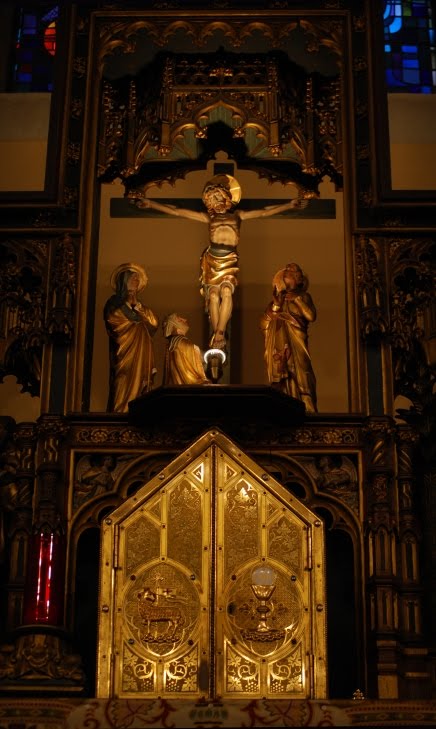
Tabernacle and Sanctuary of the
Amercian College Chapel in Leuven, Belgium

(Wednesday of the Seventh Week of Easter; This homily was given on Wednesday, 19 May, 2010 at the Chapel of The American College of the Immaculate Conception in Louvain, Belgium; See Acts 20:28-38 and John 17:11-19)

Nature abhors a vacuum. If there is a space, a gap, an empty place in the world, nature abhors it and wants to fill it in and smooth it out. Just so, there is a spiritual principle at work in our readings for today, and it goes something like this:

Just as nature abhors a vacuum, evil—and especially the Evil One who Christ names directly in our Gospel—loves a vacuum. Evil seeks out and searches for the empty places and desires to take up residence there.

Remember the parable Jesus tells in the Gospel of Luke?

When an unclean spirit goes out of someone, it roams through arid regions searching for rest but, finding none, it says, “I shall return to my home from which I came.” But upon returning, it finds it swept clean and put in order. Then it goes and brings back seven other spirits more wicked than itself who move in and dwell there, and the last condition of that person is worse than the first.
—Luke 11:24-27


Evil loves a vacuum and searches out the gaps and spaces. In our Gospel this morning Jesus is continuing that intimate priestly prayer to His Father and he indicates, before the disciples, that He is about to leave that place. He is returning to the Father in Heaven and notes how He has cared for and protected each of those entrusted to Him while He was here on earth:

When I was with them I protected them in your name that you gave me, and I guarded them, and none of them was lost except the son of destruction, in order that the Scripture might be fulfilled. But now I am coming to you.
—John 17:12-13


Jesus is leaving but He will not take them out of the world with Him; as the Father has sent Him into the world, even so, now He sends them (John 17:18). But in that prayer His continued care for them is clear:

I do not ask that you take them out of the world but that you keep them from the Evil One.
—John 17:15


The Evil One desires to come into the sacred space and Jesus Christ, in the hearing of His disciples, prays to the Father to insure that will not happen. He expects those same disciples to cooperate in every possible way to make sure the sacred space is filled with the power of faith, holiness and love.

St. Paul, in our first reading this morning, does the same. Paul is bidding farewell to the presbyters of the Church of Ephesus, and as he stands by the ship in the port city of Miletus he shares with them what the Holy Spirit has revealed to him: that they will never see his face again. Their time together in the work of the Gospel has come to a close. In that bitter sweet moment Paul says to them:

Keep watch over yourselves and over the whole flock of which the Holy Spirit has appointed you overseers, in which you tend the Church of God that he acquired with his own Blood. I know that after my departure savage wolves will come among you, and they will not spare the flock.
—Acts 20:28-29

St. Paul has the wisdom to understand that in his absence evil will desire to occupy the space that he has left behind. Therefore he exhorts them to be vigilant! He reminds them of the way he preached the Gospel to them; of how he worked among them night and day for three years; of the way he acted and spoke and how he lived his life (Acts 20:31-35).

Do the same, Paul is saying. Live a holy life in Christ Jesus; occupy well the space that God has given to you, and thus you will spare the flock and provide care and protection for the ones that God has placed among you. Evil wants nothing to do with the space that is filled with faith, holiness, charity and truth. Paul knew that…Do we?

This morning we can ask ourselves:

How are we occupying the sacred space that God has entrusted to each one of us? Are we seeking to live a holy life in Christ Jesus, to be His true disciples and care well for those entrusted to us?

Because it is not enough to remain quiet and still, avoiding evil as much as possible without ever seeking out the virtues and doing the good Christ calls us to in this world. We must avoid complacency, self sufficiency, and the mediocrity that is anathema to the spiritual life. But we must also seek out the virtues, perhaps even courageously so, in order to insure that evil has no place in our lives.

You have heard the expression, “The only thing that needs to happen for evil to conquer is for good men to do nothing.” How true that is. Please God, we are doing more than nothing in the spiritual life. But are we also seeking out holiness and virtue on a daily basis?

In 2010, to live chastity can be considered a heroic virtue; with so much to distract and tempt us, we must be all the more active and eager to cooperate with the overwhelming grace of God and live a holy life in Jesus Christ. In the culture we live in, that is so very critical, living a life of charity can be considered a heroic virtue. We are oftentimes too critical, even of each other; to live a life of forgiveness, mercy, charity in such circumstances requires even heroic virtue. Are we seeking that out and desiring—even when it is painful—the holiness of life and charity in truth without which we remain Christians in name only?

Because it is true that nature abhors a vacuum, and evil seeks out the gaps and spaces, but it is also true that we, by virtue of our Baptism, have the power of God that can fill those places with love, true freedom, virtue and the faith that has the power to change the world we live in. May we truly occupy the sacred spaces that God has entrusted to us, for our own sanctification and for the transformation of the world we live in.

Wednesday, April 28, 2010

Listening to God


(Wednesday of the Fourth Week of Easter; This homily was given on Wednesday, 28April, 2010 at the Chapel of The American College of the Immaculate Conception in Louvain, Belgium; See Acts 12:24-13:5 and John 12:44-50)

In our Gospel this morning Jesus Christ speaks a message to all—and, in particular, to those who have already made the decision to reject Him—that may have astounded them. In fact, it may even be surprising to many of us (although it should not be). He says, essentially, that everything He is accomplishing in the world, His mission and ministry, and His words in particular; all of those things, are not His own.

“Whoever believes in me,” Christ cries out, “believes not only in me but in the one who sent me” (John 12:44). But then He goes on to say:

Whoever rejects me and does not accept my words has something to judge him: the word that I spoke, it will condemn him on the last day, because I did not speak on my own, but the Father who sent me commanded me what to say and speak.
—John 12:48-49

All that Christ does, what He speaks, and the work of salvation He accomplishes in this world; all of this comes to Him from His Father. He listens to the Father, and then does what the Father tells Him. Therein lays the power of Christ. Christ’s power is not made manifest by imposing Himself over and above everything and everyone (although He could very well do that; He is the eternal Son of God and would have every right to do so). Instead, the power of Christ is revealed in His willingness to surrender Himself in humility and in loving obedience to another: His heavenly Father. The power of God is revealed in the Man who will kneel down in the dark, alone, and say: “Father…not my will but yours be done” (Luke 22:42).

Therein lays the power of Christ. Therein lays the power of the Christian. There is the power that we discover at work in the early Church, among the men and women who turned the world they lived in upside down. But they did not accomplish such a powerful transformation of their world through savvy ingenuity and a well-placed work ethic. They were powerful and effective witnesses because they listened to the voice of God and, with great love, obeyed it.

In the Acts of the Apostles, we are told this morning, the disciples were worshipping and adoring the Lord in the Church at Antioch. Suddenly, in the midst of that outpouring of praise to the Holy One, God spoke to them:

While they were worshipping the Lord and fasting, the Holy Spirit said, “Set apart for me Barnabas and Saul for the work to which I have called them.”
—Acts 13:2


We do not know how that happened; we do not know whether the Holy Spirit spoke to them out loud, or in a vision, in the form of a dove, or if someone simply discerned that God was speaking. St. Luke does not include that information as necessary in Acts. But what he does make perfectly clear is that they heard the voice of God, they listened to the Holy Spirit, and they did what God was asking. That is the power of God which allowed the early Church to set the world on fire.

That same fire is what God desires for every Christian: “I came to bring fire to the earth, and how I wish it were already kindled!” (Luke 12:49). But that fire will not happen, cannot happen, until we can kneel down, silent and alone with God, and listen well to Him. We must have the humility to be still and listen to what God is saying to us—in the midst of our own sins and difficulties, trials and the many challenges of life—but listening nonetheless to what God is trying to communicate to us. And then we must carry it out.

One of the great dangers and occupational hazards of the priest—and certainly of any vocation in the Church, as well—one of the great sources of pain, sorrow and division, is that we may begin to listen only to ourselves. Then, essentially, we say to God: “This is how it will be,” and we welcome Him to ratify that.

That is not the power revealed to us by Christ. It is not the power so evident in the lives of the Apostles and martyrs who gave everything in loving obedience to God and those they were called to serve.

And so this morning, for God’s sake; for the sake of the Church which is in tremendous need of renewal; for the sake of the men and women in this world who may never come to know the person of Jesus Christ except through us; and for our own sake, let us ask ourselves (and not be too quick to answer the question):

Who am I listening to?

Sunday, April 04, 2010

Easter: Shocked, From the Inside Out

The Resurrection, by Peter Paul Rubens,
the Cathedral of Our Lady in Antwerp, Belgium

(Easter Vigil; This homily was given on Saturday, 3 April, 2010 at the Chapel of The American College of the Immaculate Conception in Louvain, Belgium; See Genesis 1:1-2:2; 22:1-18, Exodus 14:15-15:1, Ezekiel 36:16-28 and Luke 24:1-12)


This is the first time I am able to proivide an audio recording of the homily (including the part where I almost knock over the Easter candle). I thank Mark Bentz, one of our fine seminarians here at the American College studying for the the Diocese of Portland in Oregon, for his expertise with the sound system (and for saving me the time of writing out a text for the blog!).


Please also check out the audio file of the Ave Maria, performed by the very gifted members of our music ministry here at the American College.


As always, continue to keep us all in your prayers, especially the 18 men studying here for the priesthood. A holy, blessed and happy Easter to you!


Sunday, March 14, 2010

Laetare Sunday: An Image to Rejoice In

(4th Sunday of Lent-Year C; This homily was given on 14 March, 2010 at the Chapel of The American College of the Immaculate Conception in Louvain, Belgium; See Luke 15:1-32)

Why do soldiers going off to war, to a place far away, carry a photo of their wife or girlfriend with them at all times?

Why do college students keep pictures of their loved ones, family and friends, maybe even the family pet, in their dorm room or in the place where they study?

Why do the seminarians here at the American College keep, in their rooms, a picture of me…Okay, maybe they do not do that! But why do they also keep pictures of family and friends in their rooms?

I would suggest this morning that there are two important reasons why these images are so important for us. Firstly, they are an inspiration. When times get difficult and we are struggling to find hope and courage in a place far from home, we look to these faces of the people we love and we are inspired to go on; to move ahead; to push forward even when times are tough.

Secondly, we keep these images nearby because they give us a foretaste of what we have to look forward to in the days ahead. We look at a picture of the person we love, someone who also loves us—and maybe they are also looking at our picture in the same way—and we remember that it will not be long before we are with them once again.

Even if we have a picture of a loved one who has passed away and gone home to the Lord, we remember the promise of the resurrection and are reminded that one day we will be together with them forever, please God. The seemingly infinite distance will no longer separate us.

Images of our loved ones inspire us, and they grant us a foretaste of all that lies ahead. And that is what is at the heart of the feast we celebrate this morning, Laetare Sunday. Our entrance antiphon for the Mass this Sunday, in Latin, announces:

Laetare, Ierusalem, et conventum facite, omnes qui diligitis eam.

Rejoice, Jerusalem! Be glad because of her, all you who love her.


We rejoice with Jerusalem, for her redemption is at hand! We do not wait until Easter Sunday to celebrate the mystery of our redemption in Christ. The Church teaches us that every Sunday is a celebration of Easter, whether it is in Advent, Lent or Ordinary Time. Every Sunday celebrates the resurrection of Jesus Christ.

This Laetare Sunday we are reminded that even in the midst of our desert experience, even in the middle of Lent, we have great reason to celebrate and rejoice: Jesus Christ has come, He has suffered and died for us, and is risen from the dead. Even now we anticipate that joy of Easter.

That news inspires us to push ahead and keep moving forward, no matter how difficult or discouraging things have been. But more than that, this glimpse of the resurrection, this image of Jesus Christ, risen from the dead and calling us to eternal life with Him, is but a foretaste of all that He has in store for us in the days ahead.

God wants to make sure we do not miss that picture this Laetare Sunday. Look lovingly upon our Lord today; be inspired and encouraged for all that He is planning for you!

But in our Gospel this weekend we discover one of the greatest truths about our faith and the amazing, unfathomable love of God: that long before we kneel down in prayer, before we ever raise our eyes to heaven, He is already looking upon each one of us with great love.

This weekend’s Gospel, the Parable of the Prodigal Son, is such a familiar and beautiful story. That young man demands his father’s inheritance and soon goes and squanders it all on a life of dissolute living, finding himself in a foreign land; he is hungry, alone and in dire need. It is a tragic picture of sin and one we have all experienced in one way or another. And the son does what, hopefully, all of us have done before. He comes to his senses and decides to go back home. Realizing how very well he had it in his father’s house, he makes his way back…but before he ever reaches that destination, before he ever sets his eyes upon his father, his father sees him!

Jesus, in St. Luke’s Gospel, tells us:

While he was still a long way off, his father caught sight of him and was filled with compassion.
—Luke 15:20


While he was still a long way off…

There are really only two possibilities for what Jesus describes in this Gospel. Either the father got lucky; he just happened to be looking out the window at the exact moment the son came around the bend or up over the hill (not very likely).

Or, the father stood by that window every day…waiting…Every day he stood by that window and looked out over the pathway that led to the horizon…everyday, he watched and waited, saying to himself, “Today. Maybe today my son whom I love, who has become lost, will be found and come back home…Maybe today.”

And so, suddenly, when that son finally appears, the father simply cannot help himself! He rushes out to meet that young man and embraces him, welcoming him back home.

Brothers and sisters in Christ, the Father gazes upon you and I in the same way. He sees us long before we ever see Him. He is gazing on you here. Even now.

I believe the challenge our Lord offers to us this Laetare Sunday is simple. If it is true that He is gazing at us, if He is truly looking at us even now, even here, with great love…don’t move! Do not move away at all from that gaze! Remain under the loving gaze of God the Father and ask for the grace to stay there throughout the rest of this Lenten season.

When we pray, we remain under the gaze of our loving Father. St. Teresa of Avila—whom I love because she is amazing—writes to her sisters that God is constantly looking at them with great love and when they pray, they should simply look back at Him, love for love. Prayer keeps us under the gaze of God.

So do the Sacraments. Remain close to God this Lent through frequent reception of the Eucharist, and through frequent confession. St. Paul encourages us this morning, in our second reading:

We implore you on behalf of Christ, be reconciled to God.
—2 Corinthians 5:20

When is the last time you made a good sacramental confession and allowed the love of God to renew and cleanse you, to forgive you and set you free to forgive those around you? God challenges us, through prayer and the Sacraments, to remain close to Him, to look upon Him who continually looks at us with great love.

Secondly, if it is true that God desires to look upon you with love, than certainly He also desires to look upon your neighbor in the same way; your spouse; the people you encounter each day. Let us not be like the older brother in the Parable of the Prodigal Son, getting in the way of the Father’s love for our brother. God desires to gaze with love upon those around you, and the challenge is clear: stay out of the way of that gaze!

Do everything you can to facilitate the relationship God desires with those around you and ask for the grace not to get in the way of that love through words and actions that might keep others from looking at the God who is always looking upon them.

Let us continue to rejoice together in this gaze of infinite love that the Father has turned upon us, always being inspired by His presence and encouraged in all that He has in store for us in the days ahead.

Laetare, Ierusalem, et conventum facite, omnes qui diligitis eam.

Rejoice, Jerusalem! Be glad because of her, all you who love her.


Rejoice, for her redemption is indeed at hand.

Sunday, February 14, 2010

Two Paths, and One of Them Leads to Life

(6th Sunday in Ordinary Time-Year C; This homily was given on 14 February, 2010 at the Chapel of The American College of the Immaculate Conception in Louvain, Belgium; See Jeremiah 17:5-8, Psalm 1 and Luke 6:17-26)

We are so blessed in the Catholic spiritual tradition to have a multitude of saints—doctors of the Church and teachers of the faith—who show us what it means to walk daily in the footsteps of Jesus Christ. They teach us how we can live in this life with our hearts and minds set on eternal life with God.

So often it is the mystics—St. Teresa of Avila, St. John of the Cross, St. Catherine of Siena, and even local spiritual masters from the Low Countries like St. Beatrice of Nazareth or St. Jan van Ruusbroec—that teach us about the way God works in the soul desiring to walk with Him. Very often they will mention the three ways or paths of the spiritual life: the purgative, the illuminative, and the unitive.

In the purgative way God purifies and purges our souls from the attachments we have to sin. Those sins—many perhaps even mortal which could cause us to lose our eternal salvation—which we cling to or otherwise find ourselves falling into from time to time are cleansed from our souls and we become more and more free to choose God and say no to the enticements of evil. For most of us this is a lifelong process that will be complete only in our final purification in purgatory, but God invites us to begin already that spiritual cleansing which will draw us more completely to Him.

Then, made more free and purified, we are prepared for the illuminative way; God sheds His light into our souls and illumines the path before us. We desire not only to avoid sin and the occasions which lead us away from God but, more than that, we desire and long for virtue. We seek the theological virtues of faith, hope and charity; we fall deeper in love with Christ and want to live like He lived; to love like He loved. The Holy Spirit is living and moving in us and we are being led, willingly and with great earnestness, into eternal life and ever deeper into a real and growing relationship with the Holy Trinity.

Finally, at the end of our journey, we enter the unitive way. This is not a unique status offered to a few select individuals; union with God is the call and the goal of every single one of us baptized in Jesus Christ and living in Him. In heaven, please God, each of us will be united to God—Father, Son and Holy Spirit—in an intimate and eternal relationship of love.

But the mystics teach us that we can share in that life already, even here. In their writings and poetry, their experiences of prayer (and even their sufferings) shared with us, they show us how God purifies and illumines, and can unite Himself to a soul even here, even now. Their words and examples are inspiring and they increase our own desire for the things of heaven right and a happiness that far transcends the limits of this earth.

If we look at the writings of St. Teresa of Avila we can see even more detailed descriptions of the spiritual life. In her book The Interior Castle she describes the soul as a crystal globe containing a magnificent castle. Deep within the heart of that castle resides the King of Kings, Jesus Christ.

Outside that castle, beyond the spiritual life of the soul, one finds vermin, snakes and creeping things squirming around inside the moat and in the darkness surrounding the castle keep. But once we have engaged our spiritual lives and entered within the confines of the castle we have turned from sin and begin to experience the life of grace. That is the first dwelling place. From there we journey, progressively deeper and deeper within, towards the very center or the seventh dwelling place where Christ resides. St. Teresa only reached this intimate of all unions towards the end of her life, but her account and her descriptions—like those of the purgative, illuminative and unitive ways—are remarkably inspirational.

Nonetheless, these descriptions of the mystical life can also become a difficulty and even a distraction on our spiritual journey. We can be all too tempted to gauge ourselves and try to guess exactly where we fit in at any given moment. Am I in the third dwelling place, or perhaps moving into the fourth? Am I beginning to experience illumination or am I still experiencing the purgative way at this time?

Another tendency—and never a good one—is to look at those around us and try to guess where they are in the spiritual life. We see someone who does not appear—to our own sensibilities and determinations—to have their spiritual act together. We might think, Ah, that person is definitely out there in the moat! Or maybe we will look at another person’s external tranquility and peace of soul and decide, Yes, she is certainly walking in the unitive way with God.

In my fourth year of theology I was able to take a course on the spiritual life with a very wise and holy Dominican priest. He shared with us an experience he had while still in the novitiate, preparing for priesthood. The novice master said to them:

There are only two ways and two levels in the spiritual life.
You are either in a state of GRACE…or you are NOT!

How vital is that very distinction! Everything else is gravy. Either we are in a state of sanctifying grace and God is drawing us into a deeper relationship with Him; the Holy Spirit is living and acting in and through us and preparing us for eternal life…or we are not in a state of grace but have fallen into sin and are in danger of being separated from God for all eternity.

We used to refer to that eternal separation as hell. Nowadays we do not refer to it at all. We do not talk about hell in the classroom or in the homily (God forbid). It does not come up in our social discourse or spiritual conversations. But that does not mean that it is no longer a real possibility and a danger for each one of us.

Jesus Christ talked about hell. Often. He did not talk about eternal separation from God because He was itching to shout out condemnation. He talked about it as a warning, to signal that there is indeed a path that leads away from God. If you are walking on that path, He tried to convey, then get off it! Get on the path and follow the way, instead, that leads to eternal life (see John 14:6).

If you look at the readings that we are given for this weekend—from Jeremiah the Prophet, the responsorial psalm, Psalm 1, and the Gospel of St. Luke—all of them distinguish clearly between these two paths.

Jeremiah begins with the unhappy statement, “Cursed is the one who trusts in human beings, who seeks his strength in flesh, whose heart turns away from the Lord” (Jeremiah 17:5). Cursed. That is a very stark way to begin our readings this weekend, no? He says that such a one, who leaves the Lord behind and places all his trust and efforts in the human family alone, will be like a “barren bush” in the dessert which will simply wither away and die. That is not the right path, Jeremiah is communicating in the strongest of terms!

But, he goes on, “Blessed is the one who trusts in the Lord, whose hope is the Lord” (Jeremiah 17:7). Then using the same words and imagery that we find in Psalm 1 this weekend he beautifully describes that person as a fertile tree planted beside the running water (Jeremiah 17:8; Psalm 1:3). It bears fruit in season and out of season. In the heat of the day or the dead of winter, that tree gives life in abundance, expressing the life of God and the life of grace to any and all that come in its path.

This is the tradition, says our Holy Father, Pope Benedict XVI (in his book Jesus of Nazareth) that Jesus Christ is drawing off this morning in St. Luke’s account of the Beatitudes. You may notice that St. Luke’s account is different from St. Matthew’s. In St. Matthew’s Gospel Jesus goes up on the high mountain and gives the people eight Beatitudes, eight blessed ways of following Him. In St. Luke Jesus does not go up the mountain but He remains on the plain. He is on level ground—leveling with His disciples, and with us, about the spiritual life—and he gives us not eight Beatitudes but only four. And then He gives us four “woes.”

Beginning with the blessings, He says, “Blessed are you who are poor…Blessed are you who are now hungry…Blessed are you who are now weeping…Blessed are you when people hate you…” (Luke 6:20-22). His words are somewhat disturbing. We do not usually think of these things as blessings. But they are not nearly as disturbing as the following statements:

Woe to you who are rich, for you have received your consolation. Woe to you who are filled now, for you will be hungry. Woe to you who laugh now, for you will grieve and weep. Woe to you when all speak well of you, for their ancestors treated the false prophets in this way.
—Luke 6:24-26

“These words,” says our Holy Father, “terrify us” (Jesus of Nazareth, pg. 96). If you are disturbed by Jesus words this morning, then, you are in great company! And the reason why they disturb and terrify us is because most all of us want those things. What on earth is so wrong with wanting to be filled and content in this life? What could possibly be wrong with laughter? Why would we not want a bigger bank account to take care of our families and loved ones? What is wrong with these things?

To understand the “woes” and the beatitudes in St. Luke’s Gospel we have to look at the second “woe.” He says, “Woe to you who are filled now, for you will be hungry.” The word for “filled,” in the Greek language, denotes an action that is completed and can never be increased further. To be filled in the sense that Christ is speaking of means to have a bank account that, however substantial it may be for now, can never be added to again. It is like having a brand new computer that is fast and effective, but can never again be upgraded or replaced. In ten years it will be slow and useless.

So Christ is not saying “woe” to these people simply because they have money or laugh or are filled with many good things. He is saying “woe” to them because that is all they have! They are so filled with the things of this life that they have left no room at all for the things of eternal life. They have left no room for the spiritual life or the Kingdom of God. Woe to them!

But blessed are the ones who are poor and needy, and who know it. They have lots of room for God. Blessed are the ones who are weeping and struggling and know that this world alone can never satisfy them. They are wide open to the life of grace that God offers and the promise of an eternal life of infinite bliss. Blessed are they! Blessed are they who are hungry and who thirst for a better life than this one. They have plenty of room to be filled completely with the Bread of Life and the Living Water of salvation. Blessed are they who are hated by others for the sake of Jesus Christ. They will be in the best of company with the saints and the angels when they are counted among the faithful in the presence of God.

Brothers and sisters in Christ, where are we walking in the spiritual life at this time? Jesus Christ calls out to each of us this weekend and beckons us on the path that leads to beatitude, to blessings and eternal life with Him. May we have the courage to leave all behind that does not lead us to this path, and may our interior castles be filled with light as Christ illumines us and draws us ever more deeply into a life united with Him for all eternity.

Sunday, February 07, 2010

Light Through A Window

(5th Sunday in Ordinary Time-Year C; This homily was given on 7 February, 2010 at the Chapel of The American College of the Immaculate Conception in Louvain, Belgium; See Luke 5:1-11)

In our Gospel for this weekend we have what may very well be the most insincere prayer recorded in Sacred Scripture. I do not mean that the person praying it is insincere. On the contrary, St. Peter is one of the most sincere followers Christ encountered on this earth. Yet the plea he offers to Christ in St. Luke’s Gospel this morning is one that he, in his heart of hearts, would never, ever, have wanted Christ to answer.

The scene is compelling. Peter and his confreres have been fishing all night; they have caught nothing and they are tired. Christ urges them on nonetheless: “Put out into deep water and lower your nets for a catch” (Luke 5:4). Peter heeds that call…perhaps reluctantly…and then suddenly upon seeing such a miraculous return, and finding both boats filled with fish, he begins to understand: this is no ordinary teacher, no mere prophet. This is the Christ, the Lord!

His reaction is understandable and not at all surprising as he recognizes Who this man is and how very unworthy he himself is. And then he prays:

Depart from me, Lord, for I am a sinful man.
—Luke 5:8


Now how realistic is that prayer? Remember, this is before St. Peter has seen Jesus walking on the water. They are in a boat! Where does he expect Christ to depart to? All he knows, in the immediacy of the moment, is that he is in the middle of the sea, in a boat, with God! He is overwhelmed by the recognition of his own sinfulness and the splendor and majesty of Christ. His voice pleads with Christ to leave him alone but we know, deep inside, what Peter is really thinking: Lord, please do not ever leave me! Please, Lord, do not ever go away!

It is, in many ways, one of the great paradoxes of the spiritual life: the closer we get to Christ the more we come to realize our own sin and unworthiness before Him…and the more we long, deep in our hearts, to never, ever be separated from Him, even for an instant.

Thank God that not all our prayers are answered! Christ has no intention of answering St. Peter’s request for even the slightest bit of distance or a single moment of time. He does not move one millimeter away from the fisherman from Galilee, but instead draws him into a life that will be intimately connected to Himself from that day forward.

But how do we react when our desire to be close to Christ, and the fruits of our growth in the spiritual life, reveal our sinfulness and how very far we are from the perfection God is calling us to? Do we perhaps, like St. Peter, respond by a withdrawal on the surface level? How very important that we “put out into deep water,” and go deeper with Christ so that He can reveal in us what is deep within the human heart: that innate longing we have for intimacy with Him.

St. John of the Cross, in The Ascent of Mount Carmel, talks about the soul’s union with God and beautifully describes it as light coming in through a window (Ascent, Book II, Chapter 5, #6-8). The cleaner and clearer the window, he says, the more complete the transformation of that soul will be in God.

Think about what it is like to look out into your back yard early in the morning or late in the day, with the sun shining on the grass or on the trees outside. The window looks clean enough. But let that same sunlight shine directly into that window at just the right angle and you can see all too clearly the smudges and streaks that have been there all along.

That is what it is like when Jesus Christ shines His light into our souls. The closer we get to the Light the more we can see all the smudges. But that is not the final goal of the spiritual life! We are not supposed to see all the faults and failings in our lives and then pull down the window shade in shame and disappointment (“Depart from me, O Lord!”). No, we are called to clean the window:

A soul makes room for God by wiping away all the smudges and smears of creatures, by uniting it’s will perfectly to God’s; for to love is to labor to divest and deprive oneself for God of all that is not God.

When this is done the soul will be illumined by and transformed in God. And God will so communicate His supernatural being to the soul that it will appear to be God Himself and will possess what God Himself possesses…Yet truly, it’s being (even though transformed) is naturally as distinct from God’s as it was before, just as the window, although illumined by the ray, has being distinct from the ray’s.

—The Ascent of Mount Carmel, Book II, Ch. 5, #7


Is not this what we have always longed for deep within our heart of hearts? To be fully illumined and enlightened by the merciful love of God? To be totally transformed in Him? This is the Light that St. Peter longed for, even on that boat in Galilee, despite the words that came from his lips on that miraculous and meaningful encounter with Christ.

The same Christ is calling out to each of us today. He calls us to “put out into deep water” to go deeper with Him than ever in the spiritual life. Will we cling to Him in this coming week? Will we allow Him to clean our windows through prayer, the Eucharist, perhaps through a thorough and heartfelt sacramental confession? The light is shining on us this day. May it transform us into His very likeness and lead us on to the radiance of Christ.