Sunday, September 18, 2005

Catechetical Sunday

(25th Sunday in Ordinary Time-Year A; This homily was given 18 September, 2005, at Our Lady of Mercy, East Greenwich R.I.)

It’s that time of year when many people call the rectory to ask what day or what time the religious education or CCD classes begin. It’s also the time when many students might ask, “When will CCD end?” That is the question I would like to ask this morning: When does religious education finally come to an end?

You’ve probably figured out the answer already: it doesn’t! We are never through learning about and experiencing our faith. The truths of the Scriptures and the teachings of our Faith have been described as a great pool in which the smallest child can play in, but one in which the brightest of theologians could never touch the bottom.

We can—and should—spend a lifetime swimming in that pool. This Sunday our diocese celebrates “Catechetical Sunday” and it’s a great opportunity for us to check in and ask ourselves if we have learned everything there is to know about our faith, or if perhaps Christ isn’t asking us to go a little deeper into the pool.

A couple of months ago I was in the sacristy after Mass and one of our parishioners handed me the name and address of a woman in a nearby nursing home. They told me that she had some questions about our faith and wanted to talk to a priest.

I didn’t know exactly what to expect, and when I arrived I could see that apparently, she didn’t know what to expect either. When I knocked on her door, she opened it, saw me standing there, and said, “Oh, you must be the priest. This better be good!”

As it turned out she was a baptized Christian in another denomination, but felt that God was calling her to become a Catholic . . . at the age of 82! Maybe that sounds surprising to you, unless you were here for the Easter Vigil last March, when a 76 year-old man was baptized into the Catholic Faith.

As we heard in the Gospel this morning, God is constantly out walking the streets, looking for workers for His vineyard, and he’s asking everyone, regardless of age or faith experience. But where is He asking us to grow more deeply in our faith this year?

We could ask ourselves a few basic, very practical questions:

Firstly, “Do I own I Bible, and if so, when was the last time I read it?” St. Jerome has a challenging but appropriate saying with regards to the Bible. He says, “Ignorance of Scripture is ignorance of Christ.” Reading the Bible even for a few minutes a day could be totally life-changing. I was 22 years old the first time I ever picked up the Bible and read it. It changed everything. (So be careful; look what happened to me!)

Secondly, we could ask “Do I own a copy of the Catechism of the Catholic Church?” Nearly every question about the faith you could ever ask is covered somewhere in that book. What better gift could you give to your family than the teachings of our faith?

Finally, we could ask ourselves: “What does the Church here at Our Lady of Mercy have to offer to help me grow in my faith?”

If you’re a student, the answer is the Religious Education program here at the parish. Dozens of faith filled and generous teachers have volunteered this year—as they do every year—to help our young people grow in their faith. I ask you to please keep them in your prayers as we begin classes again this fall.

But if you are an adult, there are many things you can do to grow in your faith. There is a pamphlet rack at the back of the Church that is constantly being updated and stocked to help you learn about different devotions, teachings and the lives of the saints.

We have a Book Club that is about to begin once again in just a few weeks, a great opportunity to come together as Church and discuss your faith with others. As the year continues there will be many more activities like this. Why not pick one of them and check it out?

Finally, as you may have seen in the bulletin, the RCIA program is about to start up again on October 3rd. Every year people attend these weekly classes for many different reasons. Some are preparing to make their sacraments at the Easter Vigil; like that woman I mentioned earlier, they feel that God is calling them to become Catholic. Others are Catholics who have already been baptized and confirmed but simply want to learn more about their Catholic faith.

Whatever our faith experience is, we can be assured that Jesus is walking the streets of East Greenwich this fall, looking for more workers for His vineyard, and calling each of us to grow more deeply in our knowledge of the Kingdom of God. This Catechetical Sunday, why not answer that call by learning more about the faith we profess each week?

Sunday, September 11, 2005

The Poison Tree

(24th Sunday in Ordinary Time-Year A; This homily was given 11 September, 2005, at Our Lady of Mercy, East Greenwich R.I.)

The great English poet and mystic William Blake wrote a powerful poem called A Poison Tree. In that poem he describes how he was angry with a friend but was able to express that anger and both of them were soon reconciled.

But he was angry with an enemy and chose instead to say nothing. The poem goes on to describe how he nurtured that anger, he savored it and watered it with his tears, and so it began to grow like a fresh young tree (but nonetheless, a poison tree). Eventually it bore a bright new apple, and he describes how his enemy wanted that apple, so when it was dark he came into the garden and stole it.

The last two lines of that poem are quite bitter. Blake writes:

In the morning glad I see
My foe outstretched beneath the tree.

It should come as no surprise that our bitterness, our unforgiveness, almost always ends in death: death of a friendship, death of a relationship, the loss of some part of ourselves. And there is never the satisfaction we longed for. Blake finds his foe stretched out beneath the Poison Tree, but we know that the bitterness and the anger live on; they will not end there.

Unforgiveness doesn’t always have to be as dramatic as William Blake describes it. Sometimes it can take the form of a comment or a reminder of some failure of the past. We accept someone’s apology easy enough, but every so often we remind them of what they have done to us, just so they know that we know the score.

Or maybe we don’t say anything to that person at all. Instead we tell everyone else about what they said to us, or what they did. We want everyone to know that we have been wronged. But does that help us, or make us feel better at all?

Unforgiveness is a tremendous challenge, because sooner or later we will all experience the pain of being let down. Whether it be a friend, our spouse, the people we work with, maybe even someone in the Church—often when we do not expect it, we get burned. How hard it can be to let go. How hard it can be to forgive.

The parable Jesus tells us this morning holds the key to the challenge of forgiveness. He relates that disturbing tale of the unforgiving servant. After having been forgiven for so very much, he finds himself unable to let a fellow servant off for a much smaller amount.

The root of the problem could be described as selective memory loss. He forgets, or chooses to forget, that the king “let him go and forgave him the loan” (Mathew 18:27) he could never have repaid. That’s the problem.

He should have been overwhelmed with joy. He should have gone all throughout the kingdom, saying: “Listen to this. I owed the king everything, and he forgave me.” He should have dwelt on that forgiveness, cherished it. Then he never would have mistreated his fellow servant.

That’s what God wants for us when it comes to forgiveness. It is the opposite of William Blake’s Poison Tree. Instead of dwelling on our hurts, or on those who have harmed us—as real and as painful as that is—we dwell on God, instead. We think about His mercy, His forgiveness. We think about all the times we have hurt others, or God, and remember how quick God is to forgive us, and the price He paid for that forgiveness.

We do not dwell on the wood of the Poison Tree. We remember, instead, the wood of the cross, where God paid the debt we owed and gave us His forgiveness. That is where we find the power to forgive others. It cannot come from us; we would never be able to do it. In the end, forgiveness comes from God.


Just a few years after the Second World War, a woman named Corrie ten Boom began traveling around the world, telling the message of God’s forgiveness. She had spent years in the concentration camp called Ravensbruck, where the rest of her family had died. Her message was that God forgives—even the horrors of the Holocaust—God forgives.

She had just finished that talk in a small Church outside of Munich when she saw a man approaching from the back of the room. Her blood ran cold as she recognized him. He had been one of the SS guards at Ravensbruck, and one of the cruelest. He had no idea who she was.

“A fine message,” he said. “How good it is to know that, as you say, our sins are forgiven by God. You mentioned Ravensbruck in your talk. I was a guard there. But since that time, I have become a Christian. I know that God has forgiven me for the cruel things I did there, but I would like to hear it from you, as well.”

He held out his hand to her, and at that very moment she thought of her sister, who had died in that place. She says, “I stood there—I whose sins had again and again needed to be forgiven—and could not forgive.”

But she knew the power of forgiveness; she had spoken of it so many times. She knew that forgiveness was above all an act of the will, and that she didn’t need to feel like forgiving someone in order to actually do so. Suddenly she began to pray: Jesus, help me. I can lift my hand. I can do that much. You do the rest.

And as she shook the hand of that former SS guard, she began to feel a love for him that could only come from God. She said later that she had never known God’s love as intensely as she did that day.

Who are the people in our lives that we have been denying forgiveness? Who are the ones that have hurt us or been unkind, the ones that we need to forgive today? God offers to each of us the power of forgiveness, a gift from the cross, which has the power to change our lives. Let us take that fruit from His hands today, and leave the Poison Tree behind.

Sunday, September 04, 2005

The Debt of Love

(23rd Sunday in Ordinary Time-Year A; This homily was given 4 September, 2005, at Our Lady of Mercy, East Greenwich R.I.)

Are you in debt? St. Paul says this morning that we all are, or at least that we should be. He writes to the Church in Rome:

Owe nothing to anyone, except to love one another;
for the one who loves another has fulfilled the law.
—Romans 13:8

All of us, as members of the body of Christ, owe a debt of love to each other, but love sometimes can be a difficult thing. You’ve heard of the expression “tough love”, and that “the truth hurts”. This doesn’t have to be the way, but it very often is when it comes to love.

A few months ago I was saying Mass at one of the nearby nursing homes, and two of the ladies there came by after to thank me. One of them said: “Father, I remember the first time you came here, about a year ago. You looked so young and new then. You look a lot older now.”

As I was recovering from the initial shock of that comment, the other woman said, “Yeah Father, you look like you’ve gained some weight too.” I was thinking, Get me out of here before it gets any worse! That’s tough love!

The readings this week talk about tough love. The prophet Ezekiel, in that first reading, is given instructions on what kind of love the watchman for Israel is supposed to have. He is to proclaim a message that is not his own, and to warn the people of the things that—in the end—could cost them their eternal salvation.

St. Gregory the Great, commenting on this very passage, says that whoever God sends forth as a preacher is a watchman. He points out the obvious fact that “a watchman always stands on a height so that he can see from afar what is coming.”

He is called to warn the people of the things that can harm them, and for that reason some of the hardest things that a priest has to say come from right here in this pulpit. The priest can, and should, speak about such difficult issues as vice, immorality, lack of charity, materialism, unforgiveness, and a host of other things—from the pulpit.

But the priest doesn’t live in the pulpit. Like everyone else, he too is called to live the message that he preaches. St. Gregory the Great talks very candidly about how difficult that can be. He says:

“Insofar as I do succeed [in preaching], still I myself do not live my life according to my own preaching. I recognize that I am slothful and negligent . . . So who am I to be a watchman, for I do not stand on the mountain of action but lie down in the valley of weakness.”

Now, keep in mind that this man was the Pope, he was a saint and a doctor of the Church. He’s not talking about hypocrisy, but the exact opposite. It’s an amazing expression of humility, an acknowledgement that the message he preaches is God’s message, and that God alone can give him the grace to preach it, and to live it.

He finishes that reflection on Ezekiel by saying that, nonetheless:

“Because I love [God], I do not spare myself in speaking of Him.”

St. Gregory the Great understood the debt of love. He lived it, he preached it, and he led the Church through one of the darkest periods of human history. He did so, essentially, by teaching the Church how to love.

It is not easy to live out this love in the Church. I heard a great quote the other day. Someone had written, “The greatest thing about the Catholic Church is that it’s like one big family. And the worse thing about the Catholic Church, is that it’s like one big family.”

Christ, who is the head of this family, knew how difficult it would be for us to pay that debt of love we all owe to each other. For that reason, he gives us instructions in the Gospel this morning on what to do when sin gets in the way. He says:

If your brother sins against you, go and tell him his fault between you and him alone. If he listens to you, you have won over your brother. —Matthew 18:15

It’s the basis for what is called “fraternal correction,” and if you have ever had to do it, or have ever received it, you know that it can be a very difficult thing. But there are guidelines that can help us.

Fr. Rainero Cantalamesa, who is the preacher to the papal household (the watchman of the Pope’s house, you could say) says that the ultimate reason to practice fraternal correction:

is not pride, to show others their errors in order to highlight our superiority. Nor to say: "I told you so. I warned you. Too bad for you." No, the objective is to win over one's brother. That is, to seek the genuine good of the other, so that he can improve and not meet with disagreeable consequences.


In short, the rule for fraternal correction is love. If we do not love the other, then we have no right to offer correction. But if love is present, then we have not only a right, but also an obligation to help our brother or sister to correct their faults before it is too late.

We can ask ourselves this morning: Am I doing everything I can to pay the debt of love that St. Paul talks about, and that Christ calls us to in the Gospel? Do I love the members of the Body of Christ enough to be corrected by them, or to offer correction if that is what God is asking for?

Because Christ calls each of us to be a watchman for his house, and a true brother or sister in the Church, which is the family of God.

Sunday, August 28, 2005

Cartoon Spirituality

(22nd Sunday in Ordinary Time-Year A; This homily was given 28 August, 2005, at Our Lady of Mercy, East Greenwich, R.I.)

There is a great piece of spiritual advice offered by St. Paul in this morning’s Second Reading, and it almost reads like a “Dear Abbey” column. To the Church of Rome he writes:

Do not conform yourselves to this age but be transformed by the renewal of your mind.
—Romans 12:2

It’s kind of catchy: Do not conform, but be transformed. It was advice that would have also proved quite helpful to the Romans, living in a world so completely filled with various opinions and ideas. Almost 2,000 years later, it’s still some very good advice for all of us: Do not conform, but be transformed.

There was an article in the New York Times Magazine a few weeks ago, and it had a very interesting quote. I’ll read the quote, and you can try to guess who it is referring to:

“He’s the eternal optimist. He always perseveres, he’s always got a great attitude, he always sees the positive in people.”

Who is that quote referring to? SpongeBob Squarepants. That’s right, old SpongeBob, the eternal optimist. How about that: the most positive quote in the whole magazine and he’s not even a real person! I’ll give you one final quote and you can try to guess who said it:

“If you can’t say something positive about someone,
then you shouldn’t say anything at all.”

Who said that? Mother Theresa? Pope John Paul II? No, it was a little cartoon rabbit named Thumper from the movie Bambi! Now, I don’t want to come across negative. There are many times in my life that I wish I acted more like SpongeBob, or followed the advice of Thumper.

Yet when it comes to the big decisions and the complexities of life, we need more than a cartoon spirituality. We need to do more than simply conform to the latest ideas or opinions. We need to be transformed, as St. Paul would say. Ultimately, we need God.

You may have seen the latest issue of Newsweek, with the word “Spirituality” in capital letters on the cover. The feature article describes a world of spiritually “hungry people, looking for a relationship with God.” I think that’s very accurate. Perhaps more than ever, people are searching.

If you read that article you know that they go on to explain a very American way of going about that search for God. They talked about all the various religions of our time, and put them all on a level playing field. One Boston College scholar summed up the essence of the article. He said: “Rather than being about a god who commands you, it’s about finding a religion that empowers you.”

It sounds like really good advice, and I think many people would agree with it. Unfortunately, that’s the very thing St. Paul warned the Romans about, and the same advice he offers to each of us: Do not conform, but be transformed.

As Christians, we respect the beliefs of all people of good will who are searching for God. We have a Pope who visits synagogues and embraces the Muslim world with a sincere and heartfelt desire for peace.

The Church has always recognized that there are facets of the truth in many of the religions of the world. The Second Vatican Council acknowledged that:

Those who, through no fault of their own, do not know the Gospel of Christ or His Church, but who nevertheless seek God with a sincere heart, and, moved by grace, try in their actions to do His will [guided by their conscience], those too may achieve eternal salvation.
—Lumen Gentium, # 16

But we do not believe that there are many different ways to God. In fact, we believe that there is only one way to heaven, and one plan for us to get there. In the Gospel this morning Jesus tells the disciples “that he must go to Jerusalem and suffer . . . and be killed and on the third day be raised” (Matthew 16:21). That’s God’s plan for our salvation. And that is the very thing that sets Christianity apart from every other religion in the world.

It has been said that the difference between Christianity and all other religions is a matter of direction. All religions, in some way, are searching for a way to reach up to God. Christianity is the only religion where God, who is above all things, reaches down to us. It’s the only religion where God becomes man, and dwells among us, as St. John puts it in his Gospel.

We truly believe that God, who stands outside of time and is beyond all things, entered time and space and became a man so that He could suffer and die on the cross to save us from our sins. That is the essence of our faith, that God comes to us to redeem us, comes to transform us, and to bring us to Himself to live with Him forever in heaven. But where can we find that in our daily lives? Where can we experience God, who we hunger and thirst for, as that Newsweek article so accurately pointed out?

As it turns out, God has provided a way in which we who hunger and thirst for Him can be satisfied. Before He left this world, He entrusted the gift of the Eucharist to the Church, this most Blessed Sacrament of His body and blood by which he feeds us and sustains us. We come here tired, hungry and thirsting for God, and the God who came to us as a man 2000 years ago, now comes to us anew in this Sacrament of the altar.

May we be renewed in this celebration of the Eucharist, and strengthened to live our faith more completely in this life; not being conformed, but transformed each day by the renewing of our minds, that we may discern what is the will of God, what is good and pleasing and perfect (Romans 12:2).

Sunday, August 21, 2005

Keeper of the Spring

(21st Sunday in Ordinary Time-Year A; This homily was given 21 August, 2005, at Our Lady of Mercy, East Greenwich, R.I.)

One of the most newsworthy “events” in the past 5 months has been the passing of the torch from Pope John Paul II to Pope Benedict XVI. From a highly televised papal funeral, to Pope Benedict’s election just a few weeks later, and now with World Youth Day, the papacy is front and center like never before.

But what do we, as Catholics, really believe about the Pope? This morning’s Gospel takes us back to the beginning, when Christ first designated Peter as the head of the Church on earth. Following Peter’s great confession of faith, Jesus declares to him:

You are Peter, and upon this rock I will build my church, and the gates of the netherworld shall not prevail against it. I will give you the keys to the kingdom of heaven.

—Matthew 16:18

Now he doesn’t give Peter keys in the literal sense, but that expression is an important one, because it is the basis for what is referred to as succession; Jesus gives to Peter a role that is meant to be passed on, so that after Peter’s death, another will take his place, right up until the end of time.

In our first reading this morning, the prophet Isaiah uses the same expression—that of the passing of the key—to show how the steward Eliakim will succeed the one who has gone before him:

I will place the key of the House of David on Eliakim's shoulder.

—Isaiah 22:22

The authority of the pope, the power of the keys, is a borrowed power; the pope is given an authority that is not his own. This is significant, because we are living in a time where many believe that those in authority can do whatever they want. Nothing could be further from the truth. The pope is, in fact, limited in what he can do, more limited than many would like to think.

There was an article back in 1996, in Ireland’s Sunday Business Post, in which a reporter was questioning some of the more controversial teachings of the Church. He asked one Church official if it might be possible for another pope to come along, with a different opinion than John Paul II, who might then change the Church’s teaching. That Church official said:


There are certain things the pope cannot do if he is to be obedient to the will of God . . . The Church’s teaching office is not like a government which can overturn the decisions of its predecessors.
(From Sunday Business Post, as cited in First Things, April 1996)

Now that was a man who understood the power of the keys. Little did he know that 9 years later he would be holding them! That Church official was Joseph Cardinal Ratzinger, who is now Pope Benedict XVI, and the point he was making is that the primary role of the pope is not to change the teachings of the Church, but to preserve them.

One of the most common misconceptions that many outside, and even inside, the Church have is that the pope can simply look over the teachings of the Church, select the ones he wants to, and change them, like he was selecting items in a cafeteria.

Journalists often bring up challenging issues, such as same-sex marriage, the all male priesthood, abortion and euthanasia, and they ask: When will the Church get with the times, and when will the pope change the Church’s teachings on these issues?

Pope Benedict XVI, along with every other pope right back to St. Peter himself, would answer: never, because the pope cannot change that which is true. On the contrary, his very work and mission is to preserve those truths and pass them on to the people of God.

But are we open to receiving these truths, and to putting them into practice in our lives? A recent poll showed that 74% of Catholics would follow their own conscience rather than anything that the pope would say. One of the titles of the Pope is chief shepherd of the flock. We can ask ourselves, if these people are not listening to the chief shepherd, who are they listening to? If they are not following the shepherd God has given them, than who are they following?

The late Peter Marshall, former chaplain of the United States Senate, used to tell the story of the Keeper of the Spring. The story goes that there once was a quiet old man who lived in the mountains, high above a small Austrian village.

A young town council had hired him to remove the leaves and branches that would often choke the flow of water running into the town below. Before long, the village became a popular vacation spot, where people would come from miles around just to rest in the quiet beauty of that place.

Years passed, and eventually the town council met and one of the members questioned the necessity for this mysterious “Keeper of the Spring”. “Who is he?” he asked. “No one has ever seen him, and for all we know he may be up to no good.” And so they decided to let the old man go.

For several weeks nothing changed; as fall came they noticed that the water was becoming a little discolored. Before long it became much darker, and within a week a slimy film covered the water and there was a foul odor detected all throughout the village.

The council quickly recognized their mistake and immediately hired back the Keeper of the Spring. Within weeks the river began to clear up once again, and that village regained its beauty.

The readings this weekend, and the events that are taking place in the world around us, remind us that we have been given our own Keeper of the Spring, and he has been given to us by Christ Himself.


We could ask ourselves this morning, what would our world look like, or how much more beautiful would things be—in our families, in our government, in the world we live in—if we allowed the power of the keys and the teachings of our faith to fully guide the way we live?

We are all called to be the keepers of the spring, and we rejoice this morning that God has chosen from among us a 78 year old man named Benedict to teach and guide us as we do just that.

Sunday, August 14, 2005

Do Not Disturb!

(20th Sunday in Ordinary Time-Year A; This homily was given 14 August, 2005, at Our Lady of Mercy, East Greenwich, R.I.)

Some of my favorite childhood memories come from the many summer vacations our family would take, which would often bring us to one hotel or another. It intrigued me that many of the rooms in those hotels had signs outside the door that said: Do not disturb!

And often—in order to pass the time—my brother, my sister and myself would run up and down the halls, and knock on all the doors that had one of those signs!

Now that I am an adult, I have come to a greater appreciation of the meaning of those words: Do not disturb.

No one likes to be disturbed. So it would seem only natural that Jesus is no different. As we look at the Gospel this morning, it’s easy for us to interpret the story of the Canaanite woman in those terms.

In fact, that’s the way the disciples themselves come to understand the situation. This woman, who is not from among the chosen people, comes to Jesus because her daughter is tormented by a demon. The only response she receives from Jesus is silence. So the disciples quickly jump to the next logical conclusion: Do not disturb. They say to Jesus: Send her away, for she keeps calling out after us (Matthew 15:23).

Now we know that Jesus does not grant their request; in fact, he grants the Canaanite woman’s request instead, but only after a long and somewhat awkward conversation where he even refers to her people as dogs! How are we to understand that?

Many scholars say that Jesus is using humor in order to draw out from her a deeper response of faith. That makes sense, because the woman does not seem offended; she continues to banter with Jesus until finally prayer is answered.

Whichever way we look at it, the point of the story is that this woman, who is not from among the chosen people of Israel, displays a faith which far exceeds even that of the disciples, and anticipates the very reason why Christ came in the first place: to save all peoples, all the nations of the earth.

In the first reading this morning, the Lord announces through the prophet Isaiah:

My salvation is about to come, my justice about to be revealed. The foreigners (that’s us) who join themselves to the Lord, ministering to him, loving the name of the Lord, and becoming his servants . . . them I will bring to my holy mountain and make joyful in my house of prayer. —Isaiah 56:6-7

Far from being disturbed by the prayer of the Canaanite woman, Jesus is trying to help her to see more clearly that she is not a dog, not an outsider asking for scraps from God’s table. She is herself a child of God, a fulfillment of that promise from Isaiah, and a welcome member of His house.

St. John Chrysostom says that the Canaanite woman represents each of us, the Church gathered out from the Gentiles, the non-Jewish believers who complete God’s plan of salvation. If that is true, then we should do everything we can to imitate this great woman of faith in our own lives.

But what is our response when God doesn’t seem to be listening to our prayers, when we encounter the silence of God? It didn’t stop the Canaanite woman, and it shouldn’t stop us. She received some very ambiguous answers from Jesus that day, but she never gave up, she never stopped reaching out to Jesus. Because of that—because of her faith—her prayer was answered.

Each of us can ask ourselves this morning: Are we moved by the needs we see in the world around us? Are we willing to intercede for the needs of others, to be persistent in our prayer to God even when we encounter opposition?

If we are honest, we can probably admit that all too often there is a sign on the door of our own lives, and that sign reads: Do not disturb! We want things to change in the world around us, but we are often unwilling to be the ones who work for that change. God comes to us today and knocks on our door, reminding us that we have a responsibility to pray for those He has placed in our lives, and to do at least something to work for their well being.

May we be persistent this day in our prayers and actions, knowing that the God who calls us is a God who wants to be disturbed, and that He expects each of us to be disturbed, as well.

Sunday, August 07, 2005

Walking on the Water

(19th Sunday in Ordinary Time-Year A; This homily was given 7 August, 2005, at Our Lady of Mercy, East Greenwich, R.I.)

We had one just the other night. There is one in this morning’s Gospel; and, chances are, you’ve seen more than a few in your own life. Storms. We can usually see them coming. But they can happen quite unexpectedly, like in the Gospel we just heard.

Peter and the other disciples are on the sea when suddenly they find themselves in the midst of a storm. Now, it’s important to recognize from the beginning that this would not have surprised Peter. The sea was home to him. He worked on it, made a living off it. But what does come as a surprise is the test of faith he is about to undergo.

Jesus comes out to the disciples, in the very midst of the storm, walking on the sea. Their initial reaction, far from being comforted, is one of complete fear. They think it’s a ghost, and only the words of Christ will comfort them: It is I; do not be afraid (Matthew 14:27).

And then, Peter’s faith is tested; Jesus invites him to come out to Him on the water. It’s a crucial moment for Peter, and he fails. But he learns an important lesson that he will never forget: whenever our faith is tested, whenever we experience the storms of life, we can depend on Christ to come to us, and even though we may fail, He will never fail us.

From time to time we all experience the storms of life. In a certain sense, you could say that our culture is obsessed with them; at least the storms of others. There seems to be no end to the stories in the tabloids about people in the movies or on TV whose lives have fallen apart. It can make us cynical. We can ask ourselves, “Does anyone survive in Hollywood? Is it even possible to be a person of faith there?”

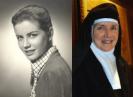
I read an article recently about a woman who was able to: Dolores Hart. Her story is remarkable. At a very young age, while she was still a freshman in college, she was given the opportunity of a lifetime to star in a movie with Elvis Presley. It was the beginning of a whole new life, and yet throughout her time in Hollywood she never lost her Catholic faith.

In that recent interview, she talked about how strong friendships with other people who shared her faith helped her to weather all the storms that have ruined the lives of so many others. She said the Lord had His hand in it from the beginning, helping her to find all the right people and guiding her life and her faith.

Yet the crisis of faith came for Dolores Hart in quite a different way than for most people in Hollywood. One day a friend offered to introduce her to a group of nuns, and her immediate reaction was: “Nuns? No. I don’t want to meet nuns”. Eventually she went anyway, to a monastery called Regina Laudis, in Bethlehem, Connecticut (about 2 hours from here) and she was captivated. The experience was one that seemed to draw her in.

She continued to make movies, continued to grow successful in Hollywood, but she never forgot that experience in the monastery. She eventually began filming another movie about the life of St. Francis of Assisi. She was playing St. Clair, and since the movie was being filmed in Rome, she had the chance to meet Pope John XXIII.

She introduced herself to him and said: “Holy Father, my name is Dolores Hart and I’m playing Clair in the movie we are filming.”

He replied, “You are Clair.”

She thought the Pope had misunderstood her, so she repeated, “No, Holy Father, my name is Dolores and I am playing Clair in the movie.”

The Holy Father smiled and repeated again: “No, you are Clair.”

Before long she began to realize that God was calling her to become a cloistered nun, like St. Claire of Assisi had been.

Her story really is incredible; she left Hollywood and joined that monastery in Connecticut, and she remains there to this day as a cloistered nun. I had the opportunity to meet her just a couple of days ago, after having read about her in that article. It’s a small world that we live in. Each year, as a fundraiser, the monastery puts on a big outdoor theatre production.

Dolores Hart, who is now Mother Dolores and the Prioress of that Benedictine Monastery, was sitting on the front row and I was sitting right behind her. She is a woman who is so filled with joy; she’s radiant. And you would never guess that she is experiencing another storm of life even now.

She has been diagnosed with a debilitating disease that causes her a great amount of physical pain, yet she smiles all the time, she’s so joyful. And you could say that she is facing that storm the same way she faced all the other storms of her life: with a deep and abiding faith in Jesus Christ.

Now, obviously, most of us have never been to Hollywood, we’ve never been in movies with Elvis. And most of us have probably never been to a monastery. But in our own lives we will all face some of the same storms that Mother Dolores faced.

All of us will experience the temptations and struggles that this world so often throws at us. We don’t have to go to Hollywood to encounter these same challenges. We will also face some of the same struggles in our own vocation, whether that be religious life or—for most of us here—marriage or the single life. However we experience the call of God in our lives, it is always a challenge to answer that call. No vocation is easy. We all experience—at one time or another—the storms of life.

But how will we respond to these storms when we experience them? Will we have the same faith and trust that Mother Dolores had, knowing that in the midst of the storm, Jesus is present. Jesus comes to us, walking on the water, walking towards us in the midst of the storm, and He says to us what He said to Mother Dolores and to St. Peter before her: “Do not be afraid. It is I.”

May we walk on the water with Jesus this week, and every day of our lives, knowing that He is always present, always near us. And when we fail, as we sometimes will in the testing of our faith, may we never forget the lesson that St. Peter learned in the Gospel this morning: that even if we fail, Jesus will never fail us. What a comfort and a consolation to know that we are never alone in the trials and the storms of life.

Sunday, July 31, 2005

The Wounded Healer

(18th Sunday in Ordinary Time-Year A; This homily was given 31 July, 2005, at Our Lady of Mercy, East Greenwich, R.I.)

There is an old legend in the Jewish Talmud in which a certain Rabbi encounters the prophet Elijah, and he asks him:
“When will the Messiah come?”

The prophet answers him:
“Go and ask him yourself.”

The Rabbi replies:
“Where is he, and how will I know him?”

Elijah says to him:

He is at the gates of the city, sitting among the poor, covered in wounds. The others unbind all their wounds at the same time and then bind them up again. But he unbinds one at a time and binds it up again, saying to himself: “Perhaps I shall be needed: if so I must always be ready so as not to delay for a moment.


This story is used by Catholic Author, Fr. Henri Nouwen, to describe Christ as the Wounded Healer. Far different from the Messiah that many expected, Christ comes as one wounded and broken, eventually dying on the cross to save us.

In this morning’s Gospel we catch a glimpse of the Wounded Healer in a moment of great weakness. Christ has just learned of the death of His cousin, John the Baptist. Naturally He is very disturbed by this and, as any of us would, He withdraws to a deserted place by Himself. No sooner does He arrive in that place, than 5,000 people come to meet Him!

Christ’s reaction to this crowd, in the midst of His own grief, is remarkable. St. Matthew says that, “his heart was moved with pity for them, and he cured their sick” (Matthew 14:14). Like the Wounded Healer in that legend from the Talmud, Christ simply rebinds the fresh wound of the death of His cousin, and begins to care for those who are sick and suffering around Him.

His response to the crowd is beautiful, as it reveals the very heart of Christ; and it’s a lesson the disciples would never forget: that even in His own need, Christ is able to meet the needs of others. Moments later, He invites these very disciples to do the same.

They approach Jesus and ask Him to dismiss the crowds while there is still time for them to find something to eat. But Jesus tells them: “Give them some food yourselves” (Matthew 14:16). What an impossible task! How could they possibly feed such a crowd, with five loaves of bread and two fish? Yet what follows is a miracle that we are all familiar with. Christ takes the loaves, blesses them, breaks them, and gives them to the disciples. Then the disciples are able to do the impossible: to feed 5,000 people with a handful of food.

This scene is familiar to us, because it’s the very thing that happens here every Sunday. Each time we gather here, around this altar, we bring before God the offering of ourselves, along with the gifts of bread and wine—offerings that, of themselves, are not enough. And yet we hear, each Sunday, those very same words:

He took the bread and gave you thanks and praise. He broke the bread, gave it to his disciples . . .


At the very heart of the Mass is the offering we make to the Lord, an offering that—of itself—is imperfect. We bring before Him our struggles and our weaknesses; our prayers and our hopes, along with the bread and wine, and offer them up in faith.

And yet, that very offering, as imperfect as it may be, is offered perfectly when it is united to the perfect offering of Christ. Each Mass we offer to the Father the one sacrifice of Christ on the cross, the sacrifice that won for us the forgiveness of sins: perfect obedience, perfect love. This is the miracle of the Eucharist; not something we watch as spectators, but a sacrifice which we are called to participate in, to unite ourselves to.

Let us not hesitate to offer completely everything we have at this Mass: our weaknesses and our strengths, our needs and our prayers, knowing that Christ is able to use even these—when they are united to His cross—to meet the needs of the world that we live in.

For we, too, are called to be wounded healers; not unbinding our wounds all at once and feeling sorry for ourselves, but unbinding them one at a time, offering them up to God—and all the while ready to be used by Christ to meet the needs of others.

Sunday, July 24, 2005

What would you do . . .?

(17th Sunday in Ordinary Time-Year A; This homily was given 24 July, 2005, at Our Lady of Mercy, East Greenwich, R.I.)

“What would you do for a Klondike Bar?” No doubt you have heard this question before and seen the TV commercial, which seems to have no end to the possible things people might do for their favorite chocolate ice cream bar. Being no small fan of both chocolate and ice cream, there are few things I wouldn’t do for a Klondike Bar!

In the Gospel this morning, the question could be asked: What would you do for the Kingdom of Heaven? (Or perhaps more correctly: What should we do for the Kingdom of Heaven?) Jesus describes the Kingdom as a treasure hidden in a field. A man finds that treasure, and “out of joy goes and sells all that he has and buys that field” (Matthew 13:44). Again, it’s like a merchant who finds that pearl of great price, so “he goes and sells all that he has and buys it” (Matthew 13:46).

The answer to the question, “What would you do?” is quite simple: give everything. The Kingdom of Heaven is so incredible, so awesome, that we are moved to give everything we have just to take hold of it. We hold back nothing when we realize that God has held back nothing from us. That’s the true image of love that God offers to us as His people.

Remarkably, St. Paul says that this kind of love—the love between Christ and His Church—is mirrored in the love that a husband and wife share in marriage (Ephesians 5). It’s important to recognize this; he does not say that God’s love for us is like the love between a priest and his parish, or a bishop and his diocese. He says it’s like the love of a husband and a wife. It reveals the great dignity of Christian marriage, yet also the great responsibility married couples have in living out such a high calling. They are called to give themselves to each other completely, even as Christ gave Himself for us, holding nothing back.

A very important document of the Church talks about this marital love, which is a total love. It calls it “that very special form of personal friendship in which husband and wife generously share everything” (Humanae Vitae, #9). Their love is so complete that it even goes beyond itself, and brings new life into being.

The document that explains so beautifully this great Sacrament of Marriage is called Humanae Vitae, and it was written 37 years ago, almost to the day. But you have probably never heard that quote before. Humanae Vitae is better known for its blanket rejection of all forms of artificial contraception. For that reason, it has become one of the most controversial documents in the Church today. But why?

The teachings of the Church on regulating the size of one’s family, on choosing when and how many children to have, are not excessive nor are they hard to understand. They are based upon that total gift of self, one spouse to another, which fully allows God to be a part of the decision making process.

Built into the very nature of marriage itself is the joy couples share in expressing their love and bringing forth new life. These two powers—the unifying love between two persons, and the creative power to bring about new life—were created to work together from the beginning, and if we want to treasure God's plan, they cannot be separated.

Artificial contraception, by its very nature, separates these two dimensions: the unitive from the procreative. It says, in essence, 'God you are welcome to be a part of our marriage everywhere, but not here.' It excludes the Author of life from an act that—by its very nature—must always be at least potentially open to the gift of life.

And the results of contraception are devastating. Humanae Vitae accurately predicted the drastic increase in the divorce rate, infidelity, abortion, and breakdown of the family's role in society. Most forms of birth control inflict harmful spiritual and physical side effects, almost always upon women. Married love is supposed to be about treasuring the gift of the spouse—body, soul, fertility, everything. Artificial contraception simply does not accomplish this end.

So what is the alternative? This week has been designated by the Church as Natural Family Planning Awareness Week. Natural Family Planning, or NFP, is a natural means by which a married couple can together read the signs of God's plan in the female body. Whether they are seeking pregnancy, or for serious reasons, seeking to avoid it, this natural method honors God's design in a way that contraception cannot.

And the benefits, as any couple that practices NFP will tell you, are outstanding. NFP couples enjoy a 99% rate of effectiveness in avoiding pregnancy, if that is their goal. It’s easy to learn, it helps communication within marriage, and NFP couples have a less than 5% rate of divorce—at least ten times less than the rest of society.

But believe it or not, none of these are the reasons why most couples change from contraception to NFP. The majority of those who make that decision do so because they feel that God is calling them to do it. Which brings us back to our original question: “What would we do for the Kingdom of Heaven?” The decision to practice NFP, as well as any moral decision in our lives, must ultimately be based not on rational facts, or benefits, or fear, guilt and shame, but on love.

We recognize that God has given Himself to us fully, holding nothing back. And this recognition moves us to want to do His will, whether it be in our family, our faith or in our personal life.

Is it easy for married couples to follow God’s will in everything? Of course not. It’s not easy for any of us. Sometimes we are confronted with decisions that require much prayer and a deeper understanding. We have to be willing to admit that we don’t always have all the answers and that we need the wisdom of God.

In our first reading this morning, King Solomon is given great power and authority; he has inherited a kingdom that is vast and expansive. And the first thing he asks for, out of all the things that he could have asked from God, is for wisdom, for “an understanding heart.”

May we be given the grace to ask for that same wisdom and “an understanding heart” in all the decisions of our lives, and may we recognize the value of the life that God has called us to, a sharing in His own Divine life, and a full gift of Himself to us. If people would be willing to do almost anything for a Klondike Bar, what would we be willing to do for the Kingdom of Heaven?

Sunday, July 10, 2005

The Parable of . . .the Spammer?

(15th Sunday in Ordinary Time-Year A; This homily was given 10 July, 2005, at Our Lady of Mercy, East Greenwich, R.I.)

A national study was done recently, which revealed that over 10,000 million pieces of junk mail are sent out each year. That’s enough for every man, woman and child to receive 160 each! And then there’s the email version of junk mail, which even has its own name: Spam. You come back from vacation to realize you have 234 new messages, and only about 5 of them from people that you actually know. “Direct marketing”, they call it; targeting large amounts of people to get at least a few of them to respond.

And so how surprising to discover, in this morning’s Gospel, that God Himself is a spammer! Jesus relates the parable of the sower, revealing the God who sows the seed that is actually His word. He sows this seed everywhere: On the path, on rocky ground, among thorns, and finally on rich soil where it will eventually bear fruit.

Why does God waste His time, and seemingly His word, by sowing it in places where it will not bear fruit? The answer has something to do with the nature of God Himself; He is a God who wants to reach us so much, wants to share His word with us so completely, that He simply sends it to us in every time and place. The miracle of grace is that, sometimes, we hear it.

“Whoever has ears,” Jesus says, “ought to hear” (Matthew 13:9). It takes a great deal of effort, in the world we live in, to hear that word. But that doesn’t keep God from sending it to us every day of our lives.

In one of her reflections on prayer, the great mystic St. Catherine of Siena describes God’s word to us as a fountain, bubbling over with fresh, life-giving water. In the city where she lived, there was a large fountain in the middle of the busy market square. During the day hundreds of people would be walking about that square, and amidst all of the busyness you could see the fountain but you certainly could not hear it.

But if you went there at night, long after all the people had retired to their homes, you could hear the water cascading from that fountain loud and clear. God’s word is a lot like that. We have to be still and quiet ourselves down, in order to hear it.

“Whoever has ears,” Jesus says, “ought to hear” (Matthew 13:9).


One of the greatest challenges that we face today is that we live in a world of many words and many distractions. From advertising, to pointless talk shows on radio and TV, and all of the other distractions of our lives; it can be difficult for us to distinguish God’s word and the importance of His message for our lives, from all the other words and messages that surround us. Yet in the midst of it all, God is sending out His word, trying to reach us and draw us close to Himself.

There is the story of a young teacher who was just beginning his career in a local elementary school. His first Christmas he was overwhelmed with joy at all the gifts he received from his students. Later that night he began to open them and discovered that there were three rectangular packages, identical in size, all wrapped in different colored paper. After opening all three, he found they were all the same thing: handkerchiefs.

After many more years, and many more Christmases, he no longer opened those small, rectangular boxes. He simply stacked them up in the closet and opened them when he needed a new handkerchief.

One winter, as he went to get a new box out for the season, he discovered that it wasn’t the typical cardboard box, but a box made of velvet. He opened that box and found not a set of handkerchiefs, but a gold watch. There was a note with the watch that said: “Merry Christmas and thank you for being the best teacher I’ve ever had.”

God’s word for us is that personal, it is that specific. We all come here, week after week, and listen to the same readings and Gospel passage together. But it will often mean something different for each one of us. For some it might be a word of encouragement, or a word of hope; for others, perhaps an invitation to change or see things in a whole new light. For each of us it is something different, but God’s word to us is as personal as that gold watch. Are we able to quiet ourselves down enough to hear it?

The great message of hope that we have as people of faith is that God never ceases to sow the seed that is His word. Long after we have given up and failed to listen, He keeps on speaking and sending out His word to encourage us, to lift us up when we have fallen, to bring us back into a deeper relationship with Himself.

As He tells us through the prophet Isaiah:

Just as from the heavens the rain and snow come down and do not return there till they have watered the earth . . . so shall my word be that goes forth from my mouth; my word shall not return to me void, but shall do my will, achieving the end for which I sent it.
—Isaiah 55:10-11

We ask God this morning for the grace to cultivate the soil of our hearts, that we might be more receptive to hearing this word, more open to what God is saying to us at this time. And hearing that word, might we go forth from this place to produce much fruit, thirty, sixty and one hundred fold.

Sunday, July 03, 2005

Take My Yoke Upon You

(14th Sunday in Ordinary Time-Year A; This homily was given 3 July, 2005, at Our Lady of Mercy, East Greenwich, R.I.)

Webster’s Dictionary defines the word burden as a weight which is carried only with difficulty. Yet for most of us, a burden is a bit more personal than that. Our burden could be the death of a loved one, a broken relationship, an addiction, an illness, problems at home or problems at work; for each of us, it is something different.

There is good news for us in this morning’s Gospel, as Jesus offers an invitation to all who carry a burden of any kind:

“Come to me,” He says. “Come to me, all you who labor and are burdened, and I will give you rest.”
—Matthew 11:28

What a consolation, to know that Jesus does not leave us to carry our burdens alone. “Come to me,” He says. And then He offers us a curious expression:

Take my yoke upon you and learn from me, for I am meek and humble of heart; and you will find rest for yourselves. For my yoke is easy, and my burden light.
—Matthew 11:29-30

Take my yoke upon you. A yoke is a plowing instrument, where two oxen are joined together—yoked together by a simple piece of wood—in order to pull the plow behind them.

There is a legend that, in his carpenter’s workshop, the young Jesus of Nazareth specialized in making these yokes. It was a tricky business, because the wood had to be crafted just right. If the yoke was too tight, it would dig into the animals, choking them. The legend has it that the yokes Jesus made were always perfect; they were made to fit easily, making the burden seem light.

Legend or not, Jesus invites each of us to receive the yoke that He himself has made, the very means of carrying our burdens not by ourselves, but with His help.

I’m sure you have probably heard the James Taylor song Fire and Rain. When it first came out in 1970, it was the song that launched his career. It placed him in the spotlight, and put him on the cover of Time Magazine.

About that same time, Taylor appeared on the Johnny Carson Show, and Carson asked him about the lyrics to that song. In particular, he was curious about one of the verses which said:

Won't you look down upon me Jesus
You got to help me make a stand
You just got to see me through another day
My body's achin' and my time is at hand
And I won't make it any other way

What most people did not know at the time, was that Fire and Rain was written when Taylor was suffering from depression and drug addiction. He shared with Johnny Carson how he wasn’t a very religious person, but he nonetheless felt, somehow, that Jesus was the only one who could help him.

Hopefully we won’t have to come to the point of desperation that James Taylor came to in order to realize that we need Jesus to help us carry our burdens. His invitation is extended to all of us:

Take my yoke upon you and learn from me, for I am meek and humble of heart.
—Matthew 11:29

Jesus wants us to come to Him and join our burdens to Him. And when we do that, when we surrender ourselves to Christ, we begin to learn from Him. We become more meek, more humble of heart. We become more like Jesus. That’s the positive side of the burdens we carry. God is able to use even our suffering and our struggles to make us more like Christ.

And even more than that, when we join our burdens to Christ, when we take His yoke upon us, we actually participate in His work of redeeming the world. He allows us to participate in His suffering, to share in the cross that He endured, and so to also share in his mission of redemption.

Everyone here this morning is familiar with the fact that, in May of 1981, an attempt was made to assassinate Pope John Paul II. His recovery was slow and painful, and for many months he was forced to carry a difficult burden, but one that he nonetheless shared with Christ; he was truly yoked to Christ in his suffering and all throughout his recovery.

About two years later, Pope John Paul II released one of his most personal documents, called On the Christian Meaning of Human Suffering (Salvifici Doloris). In that document, he talks about the Christian understanding of redemptive suffering, that even our own suffering, our own burdens, can be joined to Christ and offered up for the salvation of others. He says:

In the cross of Christ not only is the redemption accomplished through suffering. [in other words, not only are we redeemed as persons] But also human suffering itself has been redeemed.
—Salvifici Doloris, #19

Our suffering, our burdens, painful as they may be, are not meaningless. Christ is able to give meaning to our lives and even to our crosses, when we unite them to His cross, and take His yoke upon us.

And so whatever burdens we carry today, and in the days ahead, we thank God that He has not left us to carry them alone. We are yoked to Jesus, who helps us to carry our burdens, and even allows us to participate in His work of redeeming our fallen world. Being yoked to Jesus, might we find rest for ourselves, because, as He tells us in this morning’s Gospel, His yoke is easy, and His burden is light.

Sunday, June 26, 2005

Room with a View

(This homily was given on Sunday, June 26, 2005, at Holy Family Church in Poland, Ohio. I was in the Diocese of Youngstown, assisting at a wedding for a friend’s daughter, which took place that Saturday. The pastor of Holy Family Church invited me to celebrate the 9:00 a.m. Sunday Mass, on the day which happened to be my one-year anniversary of priesthood.)

I would be remiss this morning if I didn’t start off by thanking you all for the gift of Bishop Tobin, who was your Bishop for the past 9 years. The Diocese of Providence and the Diocese of Youngstown have been playing a cosmic game of chess, it seems, and we’ve just taken your bishop!

In the first reading this morning, we hear the beautiful story of the prophet Elisha, successor to the prophet Elijah (you’ll remember Elijah as the one who was taken up to heaven in a great chariot of fire).

Elisha (whose name sounds like his predecessor’s name just a bit) is a traveling prophet, and a very generous couple is so hospitable as to provide a place for him to stay each time he passes through their town. They prepared “a little room for him on the roof”, with a lamp, a table and a bed. It was an ideal place for him to come and rest, and an ideal expression of kindness and hospitality.

When I just arrived here in the Diocese of Youngstown, this past Friday, I drove in from Pittsburgh International Airport, and got all settled into my hotel room. But I wanted to spend a little time in prayer, so I called the Diocese here and asked for the location of the nearest parish. They gave me the address for your parish, Holy Family Church.

I dropped by to introduce myself, and as I rang the doorbell, I was completely unaware of the fact that you were expecting a new associate pastor any day, and that his name was also Fr. Chris! Now, you can already see where this is going.

“Hello,” I said, as the secretary opened the door. “My name is Fr. Chris Mahar, and I just got into town about an hour ago.”

She was delighted to see me! “Oh, welcome, Father! It is so nice to meet you. Would you like to take a look around?”

What a friendly place, I thought to myself. “No thank you,” I said. “I was just hoping to speak with the pastor about concelebrating Mass here this weekend.”

“Oh, I’m sure that will be no problem at all,” she said. “Why don’t you make yourself comfortable? Your room upstairs is all ready. Are you sure you wouldn’t like to take a look around and get to know the place a bit?”

A room upstairs? Get to know the place a bit? How astounding. This is the most hospitable place on the face of the earth, I thought to myself. Why would Bishop Tobin ever leave this place? Yet I began to get the impression that she had mistaken me for someone else. It was only after a few more moments of confused conversation that we cleared up who I was, and who I was not! But for a moment there, I felt like the prophet Elisha himself, with a nice little room prepared all for me!

Now, unfortunately, it’s not always that easy to follow the Lord. Things don’t always go quite that smoothly, and it often requires a great deal of sacrifice to be a disciple of Christ. This morning we find some of the most challenging teachings of Christ on discipleship and love:

Whoever loves father or mother [son or daughter] more than me, is not worthy of me.

—Matthew 10:37

Now, it sounds like Jesus is asking us to love our parents and our children less than we would want to. Of course, that cannot be the case. Christ would want us to love our parents and those in our families completely, to love them as fully as we possibly could. It’s just that he wants us to understand, when all is said and done, that we need to love God more.

We are currently experiencing a crisis in the American Church which many have referred to as a vocations crisis. Whether it be here in Youngstown, or in my own Diocese of Providence, the numbers are simply not what they used to be. Just yesterday, in Providence, Bishop Tobin ordained our newest priest, Fr. Roman Manchester. We are grateful for every vocation. But if we look around it is evident that we are experiencing a shortage of priests.

There are many factors involved in this shortage. I do not think that there are any easy answers, there are no quick solutions. However, there is something we can look more closely at this morning, and it has to do with this love Jesus talks about in St. Matthew’s Gospel:

Whoever loves son or daughter more than me, is not worthy of me.

One of the particular challenges for vocations today is that many parents and families no longer value a call to the priesthood or religious life as they once did. Wanting the very best for their children, parents will sometimes fail to support a son or daughter who feels called to priesthood or religious life.

I know this sounds sad, but I have seen it. I don’t think it is out of any intention to harm the Church or misguide their children; many of these parents want the very best for their children. Out of a misplaced love, they simply fail to recognize that the best for their child might actually be what God wants.

What is needed in the Church now, more than ever, is the same hospitality and welcome for vocations that the prophet Elisha experienced in that first reading. How would you respond if your son or daughter were to say to you this morning: “Mom, Dad, I think God is calling me to the priesthood,” or “I think God is calling me to be a nun”?

I am very fortunate to have supportive and loving parents. I’ll never forget the day I finally shared with them how I felt God was calling me to the priesthood. We were in our kitchen, and my Dad turned to me and said, “We’ve seen this coming for a while now, and we want you to know that, if this is what you think God is calling you to, and this is what He wants, we support you 100%.” What a grace that was, to have such supportive parents! They have continued to be supportive of my vocation every day since.


Now, responding to a call to the priesthood and religious life requires that same love and commitment from the one who is called, as well. We, too, must love God “more than father or mother.” I came here to this diocese to celebrate a wedding, and committing to that responsibility has placed me very far from home. Today I celebrate my first anniversary as a priest. I was ordained just one year ago today. I would love to be home right now, celebrating this day with my Mom and Dad, maybe going out somewhere special for breakfast.

But I truly believe that God has called me to be here with all of you today. Certainly, God cannot be outdone in generosity. I am not with my Mother and Father today, but I celebrate this day with many mothers and fathers, sisters and brothers in Christ, gathered here this morning. I am truly blessed to be a priest here today, and I thank all of you for your hospitality.

My prayer for you this morning is one similar to that of the prophet Elisha in that first reading. He prayed for the couple who were so hospitable to him, that they would have a newborn son by the year’s end. I pray that in the coming year you may have many more sons and daughters here in this parish, many more who will be baptized into the Body of Christ and the family of God.

And I also pray that perhaps one of your sons, or one of your daughters, will say to you: “Mom, Dad, I think God is calling me to the priesthood,” or “I think God is calling me to be a nun.” Let us continue to pray for each other, and for an increase in vocations to the priesthood and religious life, in the days ahead.

Sunday, June 19, 2005

Fear Factor

(12th Sunday in Ordinary Time-Year A; This homily was given 19 June, 2005, at Our Lady of Mercy, East Greenwich, R.I.)

One of the most basic emotions, primal in fact, is the emotion of fear. When we are afraid of something or someone, usually it is a negative experience, but fear itself is actually neutral. It can be either healthy or unhealthy. To be afraid of strangers at night might very well be a healthy fear. To be afraid of the people in your own house is not (unless, of course, you live in my house, with Fr. Lolio and Msgr. Evans. I live in fear, and lock my door each night!).

In the Gospel this morning, Jesus identifies no less than three different kinds of fear. The first one is fear of what others may think, say or do in response to our proclamation of the Gospel. Jesus speaks out quite directly regarding this one. He says, “Fear no one.” Do not fear these people at all. No matter what they threaten to do, or what they actually carry out, the Gospel takes priority, even over one’s personal safety.

Thankfully, most of us will not have to discover this reality in the same way as the twelve apostles. All of them, with the exception of St. John, were killed for their faith in Christ and their refusal to deny His Gospel.

Yet we are called to share our faith and the values our faith teaches us, even if it costs us something. We are living in a time when respect for human life and the dignity of the human person are being threatened like never before. Abortion on demand remains a legal right, and even now, laws are being created for the destruction of human life in it’s tiniest of forms . . . in the name of “science,” and in the name of “research.”

Many people, both outside the Church and even some within, say that we should remain silent; stay out of it. Yet the Gospel of Life is one that so desperately needs to be heard in our world today. We cannot be afraid to proclaim it. The value of life is so great that we are called to defend it, despite what others may think, say or do to oppose us. “Fear no one,” Jesus tells us. That’s the first kind of fear.

And from there Jesus moves on to the second kind: “Do not be afraid of those who kill the body but cannot kill the soul,” He says. “Rather, be afraid of the one who can destroy both soul and body in Gehenna.” That’s something to be afraid of.

There are worse things than the death of the body, and the loss of one’s soul is one of them. The Church prays for the salvation of all people; even the most vicious of sinners has the possibility of becoming a saint because of the mercy of God.

Yet because of the freedom that God has given us, we do not have to accept that mercy. We can choose our own sin over His forgiveness, and reject the reconciliation and the life giving relationship which God offers to us. No one is forced to go to heaven. As C.S. Lewis once said:

There are two kinds of people,
in the end;
those who say to God, “Thy will be done,”
and those to whom God must say,
with great sorrow, “Thy will be done.”

The gift of free will is a tremendous blessing and the very thing that makes us most like God. Yet we are responsible for the choices that we make. The real possibility that we could choose to reject the salvation God offers is something we should all be afraid of.

Now there is a third kind of fear that Jesus describes, and without this one, neither of the first two makes any sense. Ultimately, it’s a fear rooted in love.

Jesus describes the love God has for us as the love of a Father. He loves us infinitely, and knows us each by name. Not even a sparrow dies without God’s knowledge, and so how much more are we loved by God. What should our response be to a love like that?

The third kind of fear is what is often called the fear of the Lord. The expression “fear of the Lord” is one that is used in the Scriptures over and over again. It is one of the seven gifts of the Holy Spirit, and it is very often misunderstood. Fear of the Lord is not fear as we usually think of it. It is a fear of losing or disappointing one that we love, and who loves us more than we can imagine.

Ultimately, this is the fear that God desires from each of us, not simply a fear of punishment or a fear of hell, but a fear based on love, that makes us want to be more and more pleasing to Him. As we pray in the Act of Contrition:

O my God, I am heartily sorry
for having offended You.
And I detest all my sins,
because of the fear of the loss of heaven
and the fires of hell,
but most of all because they have offended
You, my God, who are all good
and deserving of all my love.


That’s fear of the Lord, a fear rooted in love, and one that inspires us to try to love God as much as He loves us.

As we celebrate this Father’s Day, we give thanks to God who loves each of us with a Father’s love, and has given all Fathers a model and an example of how to live and how to love. We need not be afraid to love as God loves, and to share with others the Good News that Christ has come for the very purpose of bringing us all into that perfect love that overcomes all fear.

Sunday, June 12, 2005

Ask the Lord of the Harvest

(11th Sunday in Ordinary Time-Year A; This homily was given 12 June, 2005, at Our Lady of Mercy, East Greenwich, R.I.)

One of the greatest challenges we face in the Church today is what many have referred to as a vocations crisis. Last November, Pope John Paul II alluded to this crisis, saying

No one can deny that the decline in priestly vocations represents a stark challenge for the Church in the United States, and one that cannot be ignored or put off.

On the more local level, you may have noticed in this week’s Providence Visitor that 6 faithful and hardworking priests of our diocese will be retiring this summer. Thankfully we will be celebrating the ordination of one young man to the priesthood in a few weeks, but it is quite clear that the number of priests retiring far exceeds the number of men being ordained.

The numbers can be discouraging. How are we to understand this current vocations crisis that we are in the midst of? What is to be our response to such a tremendous challenge in our Church? There are no easy answers to this situation, but one thing is certain: whatever the solution, it can only be one that is rooted in Christ and His vision for the Church.

In the Gospel this morning, St. Matthew describes a vast crowd of people who are following Jesus, and he says they were “troubled and abandoned, like sheep without a shepherd.” The original meaning of those words is so strong that it conveys almost a sense of hopelessness. One commentator says that they are words that describe “someone who is utterly wearied by a journey which seems to know no end” (Barclay).

They were weary, and the religious leaders of their time had done nothing to alleviate their suffering. In fact, they had made it worse. This is the scene which Jesus is watching unfold before Him.

St. Matthew tells us “Jesus’ heart was moved with pity for them.” The word Matthew uses is the strongest word for pity in the Greek language. It means that Jesus was physically affected by what He saw. It made Him sick! And of all the ways He could have responded—anger, frustration, cynicism—instead he simply turns to the disciples and says:

The harvest is abundant but the laborers are few; so ask the master of the harvest to send out laborers for his harvest.
—Matthew 9:36

And then He calls before Him the twelve apostles and sends them forth. Jesus saw the needs around Him. He was a realist; he understood the situation. His response is to pray to “the master of the harvest” to send out workers to be His instruments in this world. God has a plan to meet the needs of His people, and from the beginning the priesthood has been a part of that plan.

But do we truly believe that the priesthood has any relevance in meeting the needs of the world today? As we look around us and see people who are “troubled and abandoned,” much like Jesus saw in His own day, do we dare to think that the priesthood can offer some alleviation to those who are suffering and in need? Do we believe that the Sacraments of the Eucharist and Reconciliation, and the preaching of the Gospel message are able to bring consolation and strength to those in need?


In the late 18th century, the nation of France underwent one of the bloodiest revolutions the world had ever seen. It left in its wake a country devastated and a Church disintegrated and dispersed.

The attempt to abolish religion from public life had failed miserably, and now the people were suffering the consequences. In the midst of this crisis, a young man named John Vianney felt God calling him to the priesthood.

Despite his reputation for great sanctity, no bishop wanted him. He was what we would refer to today as “academically challenged,” and when one bishop finally did accept him, he assigned Vianney to a small parish in the obscure village of Ars, where it was hoped that he wouldn’t do too much damage!

St. John Vianney looked around him and saw much what Jesus saw in the Gospel today: people who were troubled and abandoned, and who no longer practiced their faith. He would often pray: “Lord, I am willing to suffer anything at all, only convert my people. That is all I ask.”

Many years went by, and eventually things did begin to change. It was slow at first, but eventually people began to come back to Church. Before long, the entire village was converted, and many became convinced that their parish priest was a saint.

At that time the most remarkable thing began to happen. People from all over France started to make pilgrimages to that small village. Thousands of people came there to attend Mass and to have their confession heard by this simple and unimpressive priest. Not only Ars, but all of France was being converted. There is a story that one day the devil himself confronted John Vianney and shouted at him through a possessed person:

Curse you John Vianney! If there were three of you,
I would not be able to set foot in all of France.

That was 150 years ago. Today, in our own country, we thankfully do not face the same challenges that France was up against. Nonetheless, we have our own problems, our culture has more than its share of people who are “troubled and abandoned.” And in the midst of all these challenges, our Church is facing a crisis of vocations.

Might we all more fervently pray to the “Master of the harvest” to send out more laborers. It would be wonderful if we had 30 more vocations to the priesthood in our diocese in the coming year. But if we only had three, it could very well be enough for God to accomplish the work that He desires in our Church, and in the world around us.

Sunday, June 05, 2005

What God Sees

(10th Sunday in Ordinary Time-Year A; This homily was given 5 June, 2005, at Our Lady of Mercy, East Greenwich, R.I.)

The other night I was at a Sports Banquet, a fundraiser for a religious community in Connecticut. Towards the beginning of the evening I noticed a man who was obviously underdressed. It was a black tie event, and this man was wearing a neon red golf shirt. Without being judgmental at all, I felt kind of sorry for the man. There were famous people there, great athletes and sports writers; and here was this poor guy, who looked so very out of place.

When the time came for the keynote address, the Master of Ceremonies introduced Baseball Legend and Hall of Fame Manager Sparky Anderson. And sure enough, up to the podium went that man in the red golf shirt! As calm as could be, he laughed as he told the story about losing all his luggage at the airport. And then he went on to give one of the most beautiful talks on the Catholic faith that I had heard in a long time.

All I had seen earlier that night was an underdressed man in a golf shirt. But there was much more going on that I could not see, so much more to this person than I could have imagined.

This morning Jesus is walking past the customs post, and we are told that as He went by, “He saw a man named Matthew” sitting there. He saw Matthew. But what did Jesus see as he looked at this man who was no doubt despised by nearly all of his peers?

Later on, in Matthew’s house, the Pharisees will look and see only a group of “tax collectors and sinners.” That’s it. But Jesus looks and sees so much more than that. Jesus looks at Matthew and He sees an Apostle. He sees a man who will one day be a saint. He looks Matthew in the eyes and says: “You, follow me!”

What Jesus sees in Matthew, and how Matthew responds ,can say a lot about our own personal relationship with God and how we are to be followers of Christ. When we look at the people around us, what do we see? How about when we look at ourselves? Do we see a person who doesn’t really matter all that much to the world we live in? Someone who is no different from anyone else in the world? Is that what God sees? It’s not what He saw in Matthew, and it’s probably not what He sees when He looks at each one of us.

The artist Michelangelo was one of the most gifted painters of all time, but his true passion was not painting; it was sculpting. If you have ever seen the Pieta in St. Peter’s Basilica, you can quickly see why. That image of Mary holding the body of her Son is one of the most moving works of art ever created.

When asked about the method he used in sculpting, Michelangelo would always say that his work was not about creating something new. He truly felt that each block of marble held some magnificent work of great beauty. The work of the artist, he would say, is to set it free from the marble, to remove all the excess material and reveal the incredible beauty that was held captive within.

That magnificent beauty is what God sees in each one of us. It is His intention and desire to reveal that beauty in our lives. That’s why He calls us, as He called St. Matthew, to follow Him. Our work in unveiling that beauty, and becoming all that God sees in us, is the work of a response. We must respond to God and His call in our lives if we are ever to become all that He sees in us.

In his book The Truth of Catholicism, papal biographer and theologian George Weigel refers to this call of God and its response as the drama of every soul. He says that:

Each Christian life, including the lives of the saints, is lived in the gap between the person I am and the person I ought to be.

The reason we hold up the saints as models of what it means to follow Christ is because they never stopped trying to close that gap; they never lost sight of what God saw in them, and they never gave up trying to live up to that call of love.

As we strive to answer the call of God in our own lives this week, may we also see what God sees, and never stop striving to live out the virtues God desires us to grow in. Wherever the customs post is for our own personal lives, Christ is walking by today, and calling out to each of us: “You, follow me!”